1970s

Pop Culture Affidavit Episode 58: Movie Songs!

Episode 58 Website CoverIt’s time for YET ANOTHER PLAYLIST EPISODE! Inspired by Andrew Leyland’s movie scores episode of “The Palace of Glittering Delights,” I’ve compiled a playlist of songs from movie soundtracks that are both classic and obscure but are in many ways spectacular. I’ve got Simon & Garfunkel, The Bee Gees, Queen, Irene Cara, and (of course) Kenny Loggins. So many movie memories! So many songs left off the list!

iTunes: Two True Freaks Presents Pop Culture Affidavit

Direct Download

Two True Freaks Presents: Pop Culture Affidavit podcast page


Pop Culture Affidavit Presents: 80 Years of DC Comics Episode 15 — Christmas

80 Years Episode 15 Website LogoWell, it’s been a month since Christmas and you’ve all finally listened to all of the holiday-themed episodes that everyone else on the TTF network put out … so why not one more? That’s right, folks–we’ve kept the lights up and drinking egg nog way past its expiration date to bring you a look at FOUR Christmas-themed DC Comics. First up is a treasury-sized Rudolph the Red-Nosed Reindeer read by yours truly and Brett, complete with running commentary. I follow that up with Stella who discussed a Golden Age Batman story live at our local Starbucks. Then, it’s time to check in with the boy of steel and the Legion of Super-Heroes in a classic story that I reviewed with Michael Bailey. And finally, I fly solo for Team Titans #6. It’s festive! It’s jolly! It’s a month overdue!

Here’s where to listen:

iTunes: Two True Freaks Presents Pop Culture Affidavit

Direct Download

Two True Freaks Presents: Pop Culture Affidavit podcast page

Pop Culture Affidavit Episode 55: Where Dreams Come True (Summer 2015 Part Two)

Episode 55 Website CoverThe summer 2015 recap continues with a Walt Disney World episode! Join me, Amanda, and Brett as we head to Orlando in July and cover past and present vacations, what we loved doing, what we loved to eat, and a little bit of Agent P’s World Showcase Adventure!

Here’s where to listen:

iTunes: Two True Freaks Presents Pop Culture Affidavit

Direct Download

Two True Freaks Presents: Pop Culture Affidavit podcast page

And now for some bonus material!

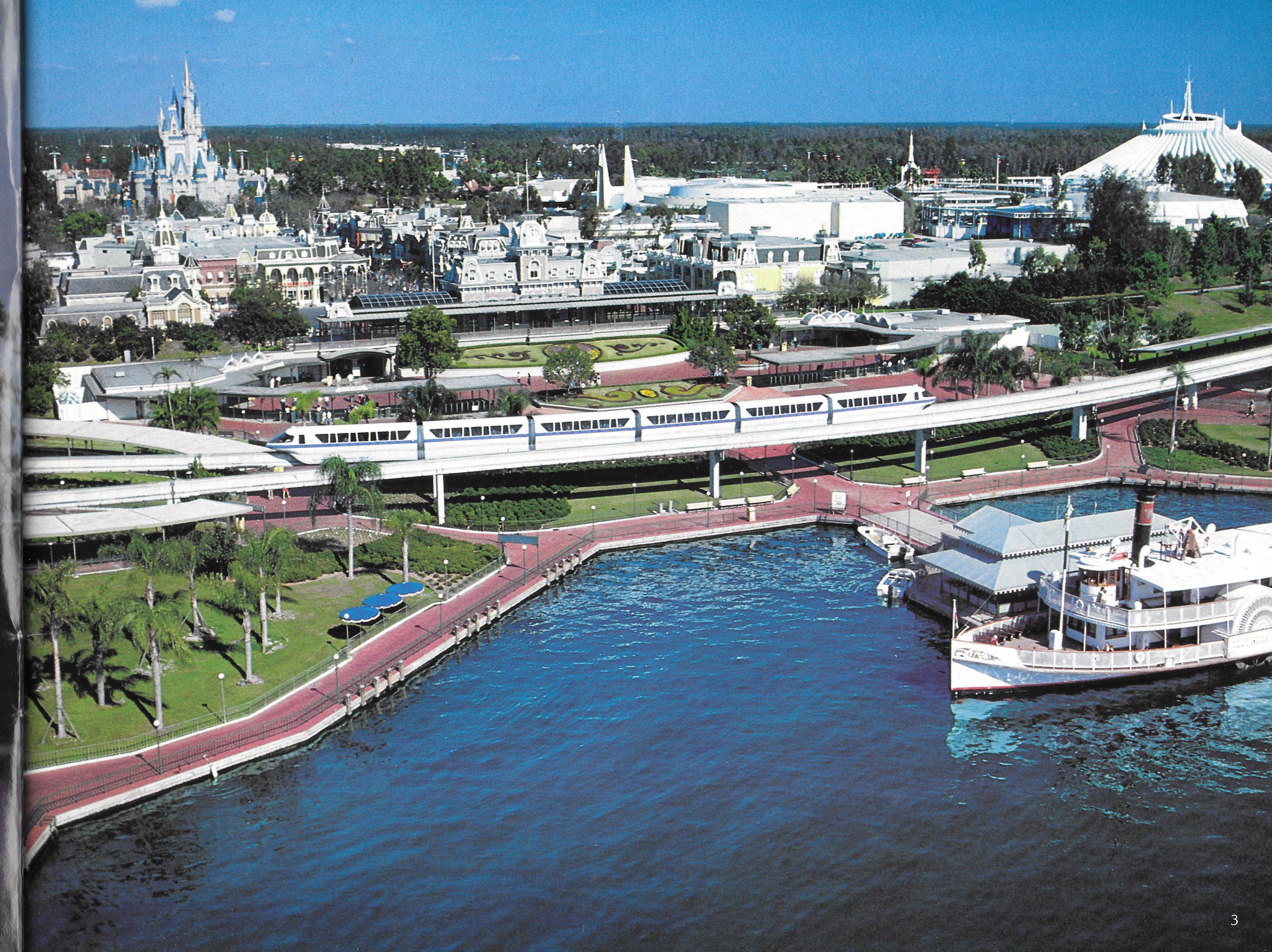
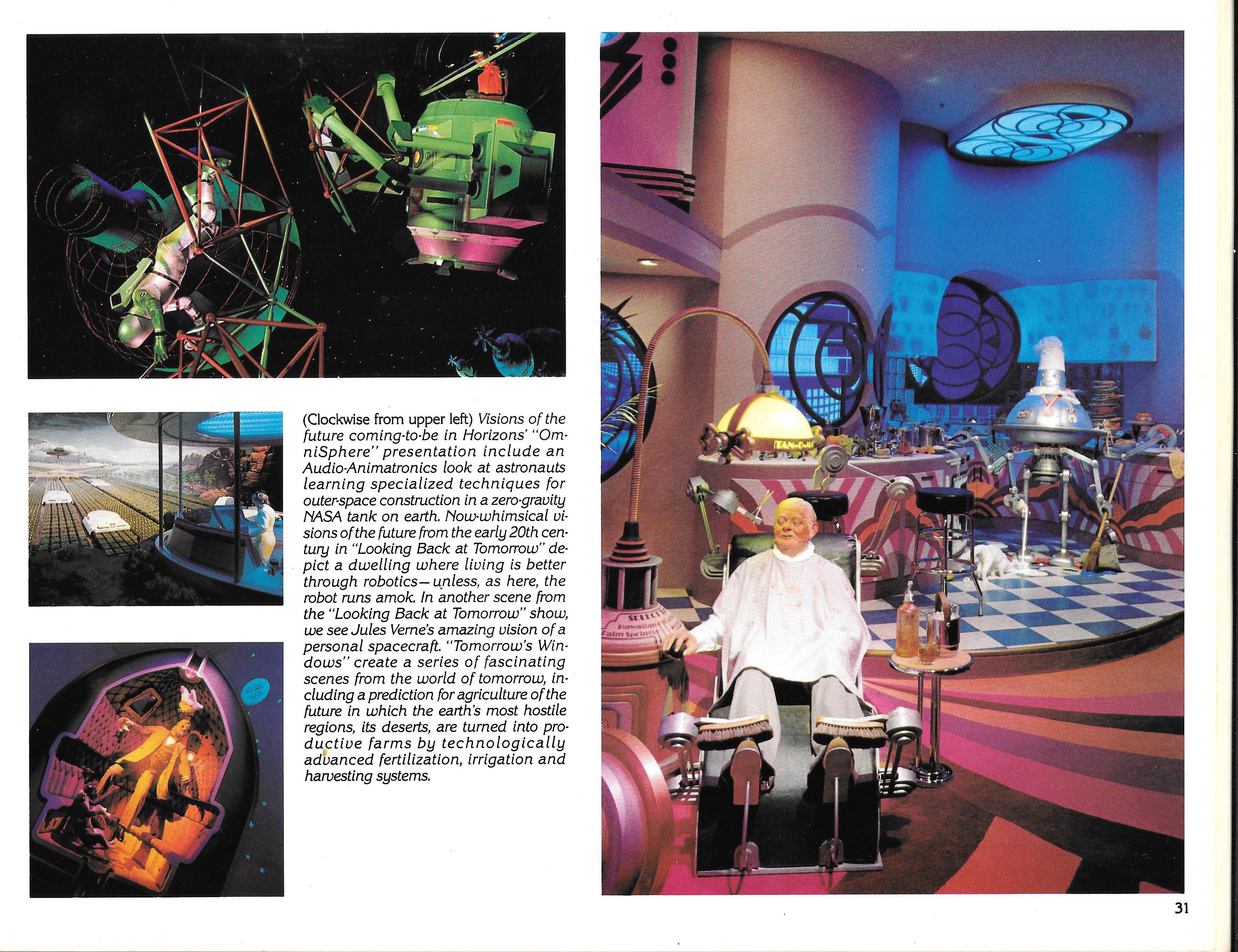
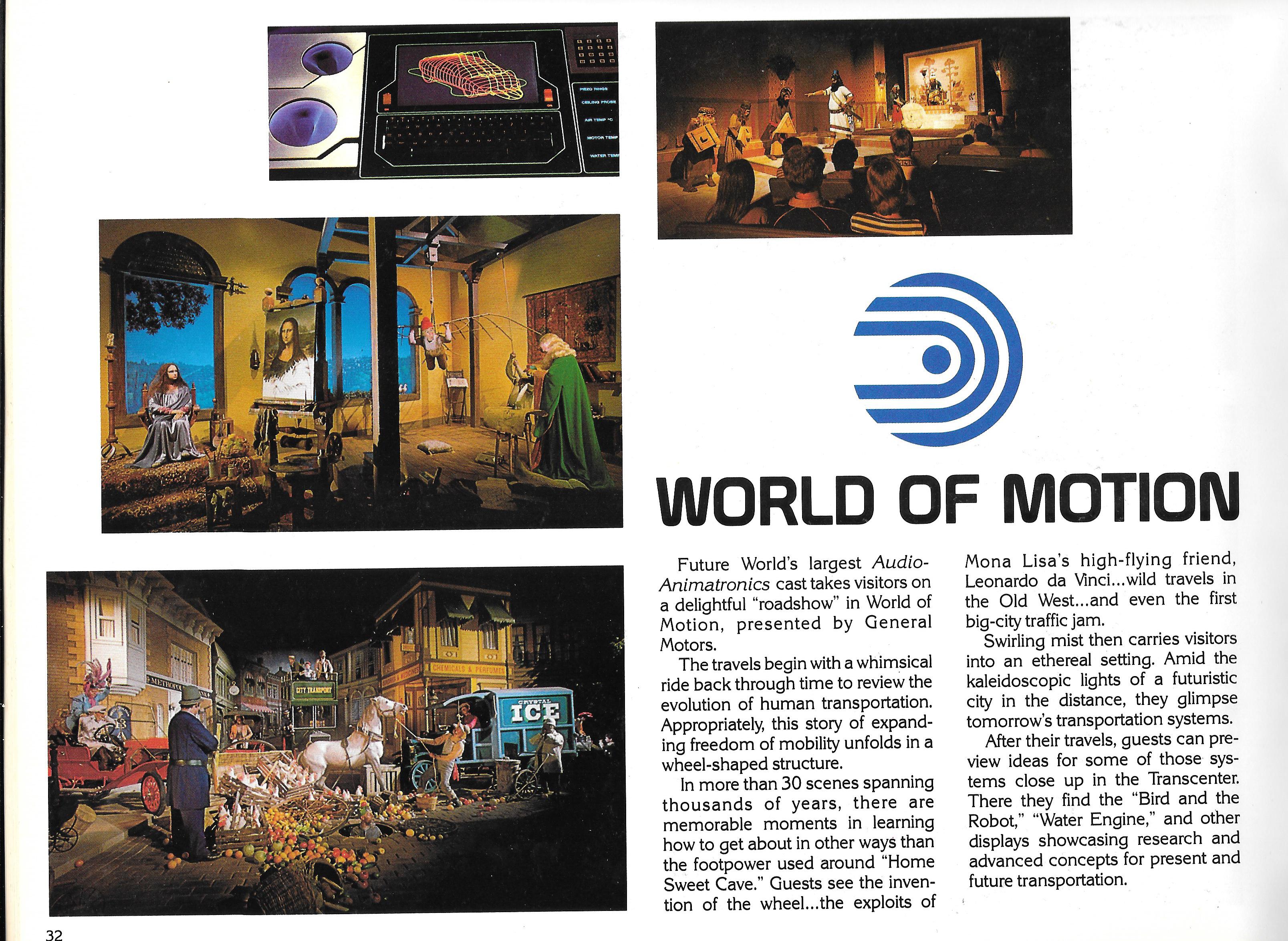
During the show, I talk about my past experiences at Walt Disney World and also read the section on the now-defunct EPCOT Center ride Horizons found in Walt Disney World: A Pictorial Souvenir, which was published in 1984 and I received either right before or during my first trip to Walt Disney World in 1985.  Below are some scans of the book for you all to enjoy.

First, the cover:

Disney Guidebook Pictures0001

The beginning of the section of The Magic Kingdom, featuring a gorgeous evening shot:

Disney Guidebook Pictures0021

Disney Guidebook Pictures0022

Main Street, U.S.A.  I particularly like this page because of the perspective in the picture on the lower left.  You don’t get that view very often.  Plus, I have to admit that the lack of a crowd in the picture on the lower right is amusing:

Disney Guidebook Pictures0023

Two of the pages on Fantasyland.  I chose the first because of that gorgeous shot of Cinderella’s Castle with the purple sky behind it.  The second, I chose, because it has a picture of the skyway that ran over Fantasyland but closed in 1999 (fun fact: Disneyland had a similar skyway, which took you through the Matterhorn, which sounds awesome):

Disney Guidebook Pictures0024

Disney Guidebook Pictures0002

A quick look at Tomorrowland, which is definitely one of the lands of the magic kingdom that changed the most since I was a kid.  I rode the Astro Orbiter for the very first time this year, although I have to admit that part of me wishes I’d ridden it back in the day when it had its classic look:

Disney Guidebook Pictures0003

The opening of the EPCOT Center section of the book, complete with the old EPCOT Center logo.  I own two vintage-style T-shirts with the logo:

Disney Guidebook Pictures0004

The two-page spread about the EPCOT Center attraction known as Horizons.  This is the section of the book I read on the air.  A little more history about Horizons:  it opened in 1983 and was part of the “phase II” of EPCOT construction/attractions.  It closed in 1994 but was reopened in December 1995 and then closed permanently in 1999.  The attraction was completely disassembled and demolished and is now the home of Mission: Space.  You can see some of the pieces of the Horizons ride on display in the lobby of Walt Disney: One Man’s Dream theater in Hollywood Studios.

Disney Guidebook Pictures0005

Disney Guidebook Pictures0006

Another defunct ride in EPCOT is the GM-sponsored World of Motion.  This was one of the original EPCOT Center Future World rides before it closed in 1996.  The building still remains, as it was refurbished for what is now the Chevrolet-sponsored Test Track:

Disney Guidebook Pictures0007

Disney Guidebook Pictures0008

CommuniCore is the original name for what is now known as Innoventions in EPCOT’s Future World.  The buildings haven’t changed in structure–they are still two half-circles right behind Spaceship Earth–and there are still restaurants and gift shops.  The original exhibits were more thematically linked to the various pavilions in Future World, but the Innoventions ones seem to be more of their own thing.  If I may editorialize for a moment, I hope something more interesting is done with Innoventions because while some of the exhibits and interactive games are pretty cool, it seems like there is a lot of wasted space in those buildings:

Disney Guidebook Pictures0009

Disney Guidebook Pictures0010

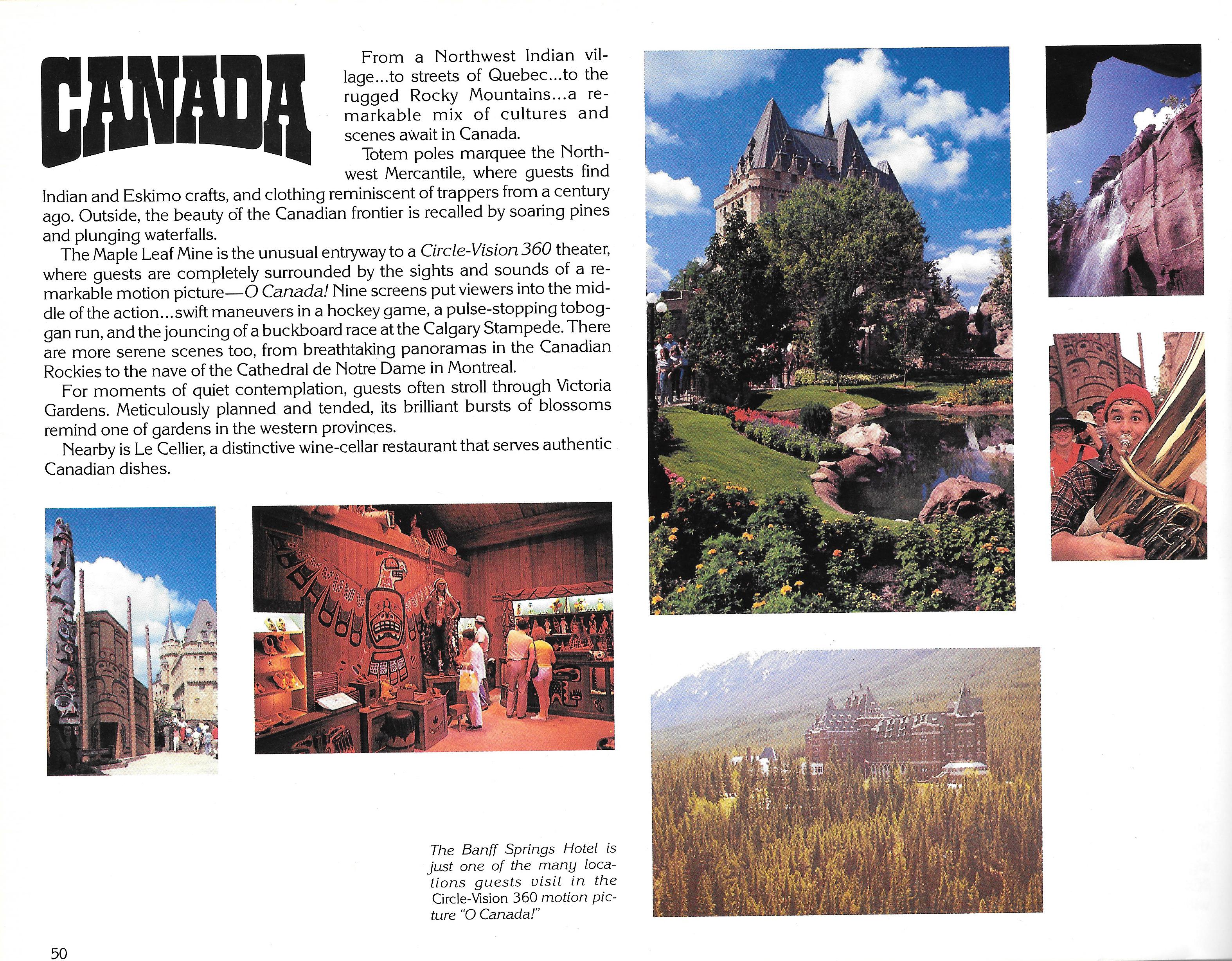
The page on Canada in the World Showcase.  Because Canada is awesome, has one of my favorite gift shops in EPCOT, and there’s a guy playing a tuba:

Disney Guidebook Pictures0011

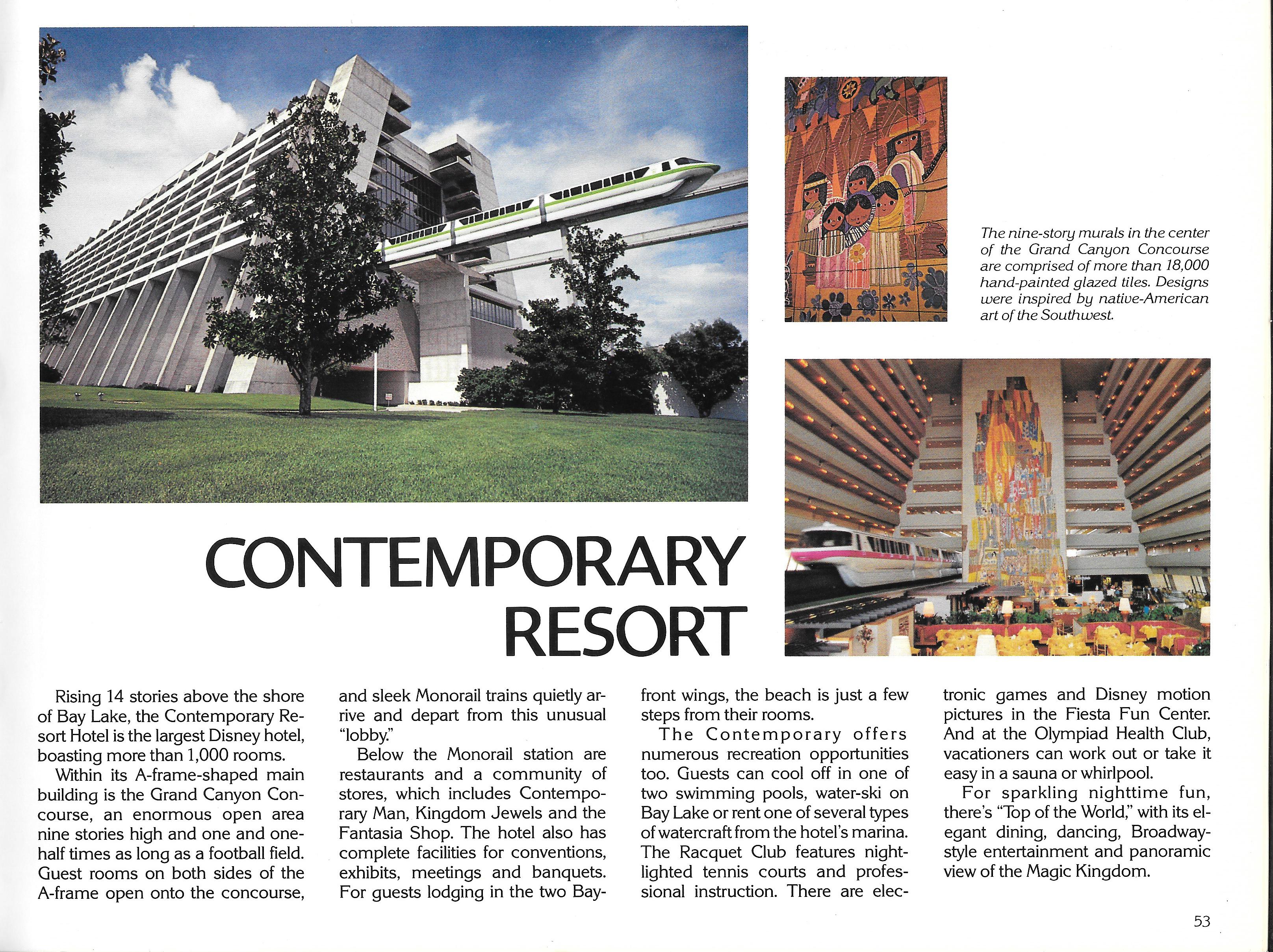
One of the souvenir guidebook’s pages on the Contemporary Resort hotel.  This one was always a personal favorite of mine, as I think it is with a lot of kids, because it’s the one that the monoral drives through.

Disney Guidebook Pictures0012

Here are some pages on Discovery Island, the now-closed zoological park that was part of the Walt Disney World resort until 1999.  And if you’re interested in more, here’s a link to a blog post by Shane Perez, who explored the closed facility in 2009:  The Photography of Shane Perez — Discovery Island:

Disney Guidebook Pictures0013

Disney Guidebook Pictures0014

River Country was Walt Disney World’s first water park and operated seasonally until November 2001.  It was scheduled to reopen in 2002 but that never came to be and the park now sits abandoned:

Disney Guidebook Pictures0015

One of the other resorts that you could stay at in 1984 was the Golf Resort Hotel.  The property has since been sold off and from what I can tell is no longer part of the Walt Disney World resort; however, if you’d like a trip down memory lane, the blog Passport to Dreams has an excellent post about it from 2012:  Passport to Dreams–Return to the Golf Resort:

Disney Guidebook Pictures0016

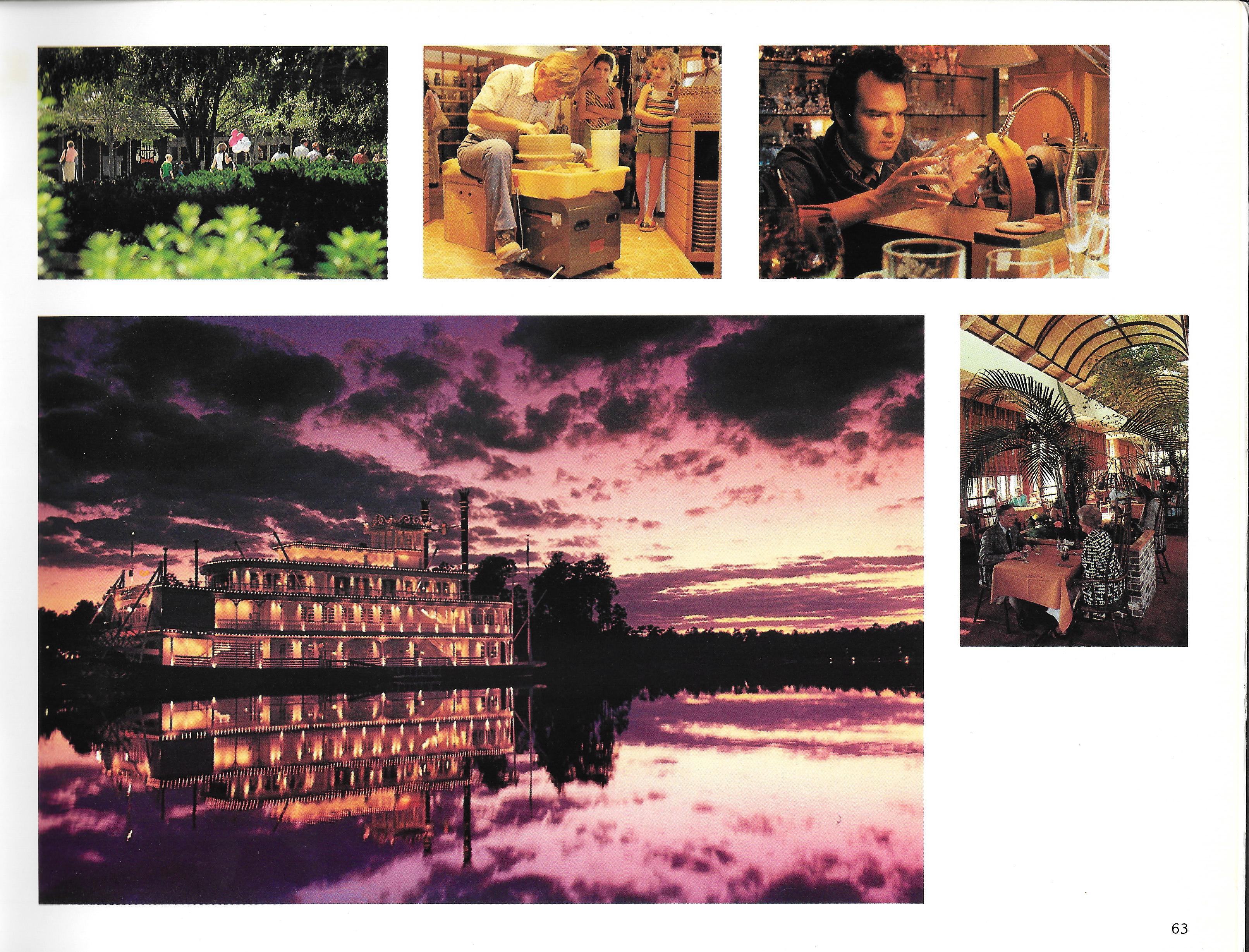
Two other areas that have been around since the park’s earliest days in the 1970s are Lake Buena Vista and Walt Disney World Village.  I am not sure if Lake Buena Vista still functions as a resort the way it did back in the 1970s and 1980s, but you can still shop at the Walt Disney World Village.  Except they don’t call it the Walt Disney World Village anymore–it was renamed Disney Village Marketplace in 1989, Downtown Disney in 1997, and Disney Springs on September 29, 2015:

Disney Guidebook Pictures0017

Disney Guidebook Pictures0018

Disney Guidebook Pictures0019

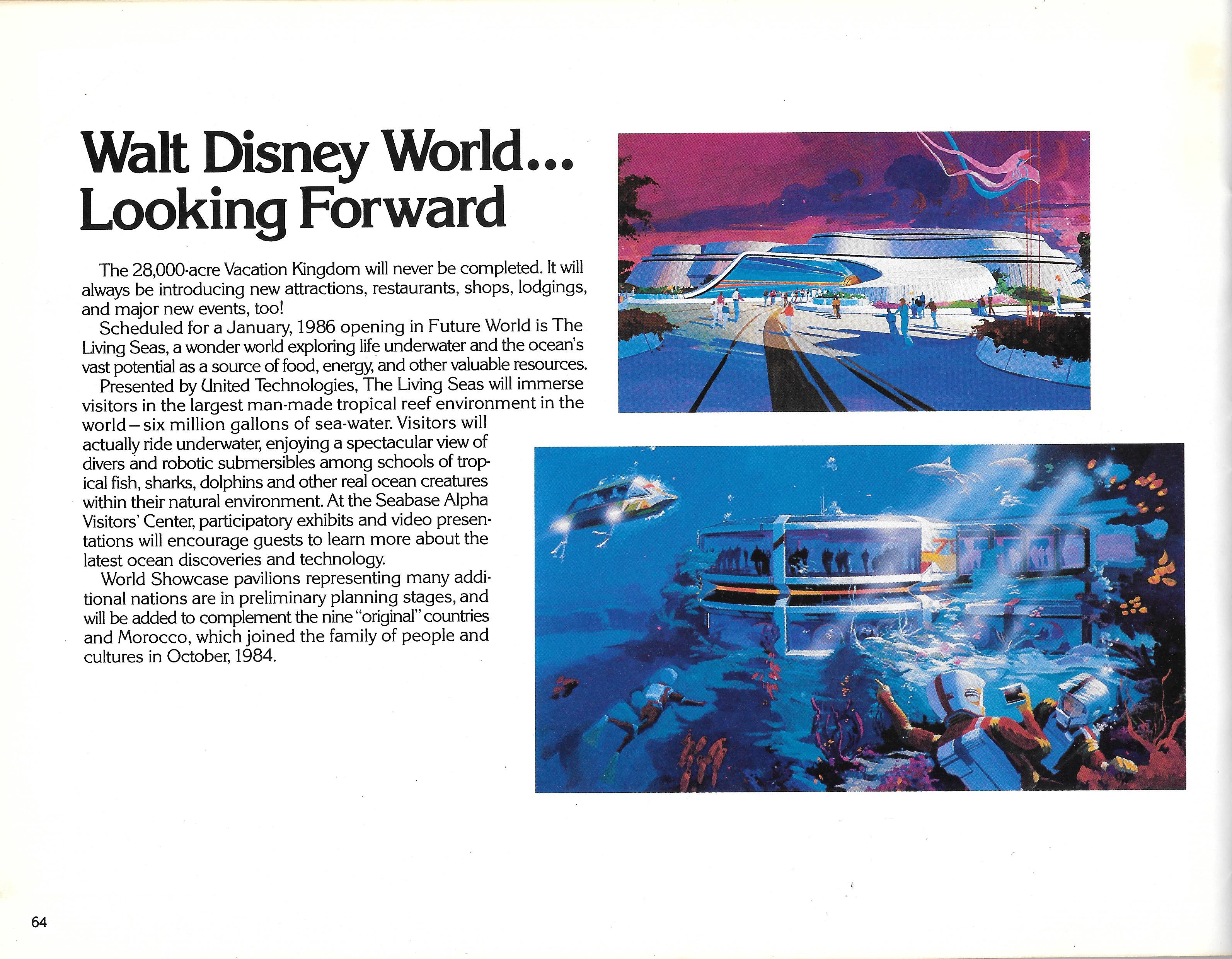
Finally, a look ahead at what was coming to Walt Disney World in 1986, the new EPCOT Center Future World attraction known as The Living Seas:

Disney Guidebook Pictures0020

Pop Culture Affidavit Episode 53: The Softacular

Episode 53 Website CoverRemember all of the awesome music we used to jam to growing up in the ’80s and ’90s?  Remember all of the important bands that you heard just as they came out and before they became huge?  Well, in this episode I’m going to take you on a nostalgic musical journey that has absolutely NONE OF THAT!  No, it’s time for an honest look at our formative years with 16 memorable soft rock and pop hits from the 1970s and 1980s, the same hits I was forced to endure while sitting the back of my parents’ car on the way to my grandparents’ house.  So buckle up … it’s time for The Softacular.

You can listen here:

iTunes:  Pop Culture Affidavit

Direct Download 

Pop Culture Affidavit podcast page

And for your viewing pleasure, here are the videos I could find to accompany everything used in the episode.  I made every effort to find either an official music video or a live performance from the time when the song was popular (after the cut) …

(more…)

Musical Biography or Archaeology?

The cover I made for "Past Lives and Long-Lost Friends," which I originally burned onto two CDs.  The idea for the cover came from a  timeline feature in my high school yearbooks.

The cover I made for “Past Lives and Long-Lost Friends,” which I originally burned onto two CDs. The idea for the cover came from a timeline feature in my high school yearbooks.

I don’t know if I realized it at the time, but following up a song by The Weepies called “Can’t Go Back Now” with “Summer, Highland Falls” is kind of a definite statement.  The latter’s first lines are, “They say these are not the best of times/they’re the only times I’ve ever known.”  While I can’t confirm this, I am pretty sure I wrote that in a friend’s yearbook at the end of my senior year (or at least I was thinking of it).  It has always been one of my favorite songs and at the time I graduated high school, it fully encapsulated what I was feeling.

I’m pretty sure that is why it wound up on a playlist I made back in 2010 called “Past Lives and Long Lost Friends.”  Silly as it sounds, I put it together because at the time, I was fifteen years away from that day in late June of 1995 and the mix tape, at the time I was a teenager, was my preferred form of artistic expression.  if you were a girl I was dating (or a friend on whom I was crushing), you more than likely wound up with a 120-minute Maxell normal bias cassette that may or may not have had a custom label created using Arts & Letters, an ancient Windows 3.0 graphic design program.  Now, I’m not sure how many of those girls kept my tapes.  My wife did, but I think that’s because she never emptied them out of her car (a car, by the way, that I now drive to work every day).  But the old girlfriend whose relationship with me ended in utter disaster?  She probably torched them all the moment after I gave her one final goodbye over the phone (not my idea, mind you; she forced my hand).  And some of those other girls?  Part of me hopes that a copy of “The Last Worthless Mix Tape” is floating out there, playing in the old tape deck of someone who is feeling sentimental.

Which brings me to this five-year-old playlist that’s still on my iPod.  Like I said, I was hitting the fifteen-year mark and was feeling sentimental, so I began dragging and dropping songs into a playlist.  The phrase “long-lost friend” had been bouncing around my head for a while as had the idea of my having led a past life, or everyone I know having led a past life.  Because when you think about it, the people you are around on a daily basis have stories that are bigger than the one they have with you.  Or maybe I just notice this because it’s the curse of the writer’s mentality.  But the idea that everyone is interesting in a way, that there is always something to find out about them, is fascinating.

It seems completely pretentious to me try and encapsulate that in a mix, and looking at the song list, it probably could be at least five songs shorter.  It still would fit on a 120-minute cassette, but there are too many anthemic songs of youthful defiance (“We’ll Inherit The Earth,” “Death or Glory”) or aging punk anthems (“Scattered,” “I Was a Teenage Anarchist”) and the middle drags on through some very slow and soft folk pieces that don’t hold up (“See You Later, See You Soon,” “This is Me”).  But it was good enough to earn “permanent playlist” status.  Either that, or I was just too lazy to delete it, which is probably the more likely explanation as to why it has spent five years on my iPod.

Mix tapes seem to be this thing that is a part of my youth, whereas playlists are something you throw together because you want to listen to a variety of songs, often with the same rhythm or tone.  I make workout playlists (admittedly, I probably should start working out more often), Christmas music playlists, dinner music playlists, and even a breakfast playlist that is filled with French jazz and other brunchy music.  It’s all very adult because it serves a practical purpose, an extension of the tapes called “Tom’s Crap” that I used to make so that I had something to listen to on my Walkman or in my car.  Part of me shrugs at this, but part of me is saddened.

There was a point in my life where everything had meaning.  If I gave you a tape, it was because I wanted to say something or introduce you to something.  And no matter how crappy that tape was–and trust me, some of those tapes were crappy–I thought it was important.  “Past Lives and Long Lost Friends” was an attempt at making something important like that and also an attempt to hold on to the self-importance that comes with “meaning,” as if I am attempting to dispute the statement that Ally Sheedy so boldly makes in The Breakfast Club: “When you grow up, your heart dies.”

At seventeen, I believed her; at 37, I’ve come to realize she’s wrong.  You simply turn your focus elsewhere.  Adulthood is priorities and responsibility.  It’s not that I don’t want to sit and contemplate an entire album for an hour; it’s just that I don’t always have the time.  My geeking out happens amidst a flurry of multitasking and when I do get those moments to contemplate, I usually fall asleep in front of the television.

I’ve heard Billy Joel explain the meaning of “Summer, Highland Falls” as hitting that point in his life where he was starting to see the world for what its complexities.  Much of that playlist, if you look at several of the songs, is a similar contemplation but I don’t know if I was contemplating graduating high school as much as I was coming to terms with the onset of middle age.  At seventeen, I would have never put “Late for the Sky” by Jackson Browne on a mix tape (granted, I’m pretty sure that “Running on Empty” and “Somebody’s Baby” were the only Jackson Browne songs I knew), nor would I have considered Paul Simon essential listening.  If I was being contemplative or sentimental, I would have chosen 10,000 Maniacs, but mostly I would have gone for the bombast of Queen.

To be honest, I have thought about making a Twenty Years On mix.  I can’t decide if I would go for nostalgia or reflection, though.  Twenty years kind of dictates that I should throw together a collection of the Pearl Jam, Green Day, Guns N’ Roses, Metallica, Queen, Led Zeppelin, Bruce Springsteen, and Billy Joel that I listened to in a Big Chill soundtrack sort of way.  Being reflective would be more of what I did five years ago, which might be belaboring the point.

“Summer, Highland Falls” ends with a few lines that have always stuck with me:

How thoughtlessly we dissipate our energies
Perhaps we don’t fulfill each other’s fantasies
And as we stand upon the ledges of our lives
With our respective similarities
It’s either sadness or euphoria

It’s a final statement worth a close examination.  If it is, as he says, the a moment of realizing that you’re getting older, it’s a perfect expression of that realization.  There’s no violent anger here, just acceptance and resignation.  Perhaps, even, there’s a bit of maturity.  Place this in the larger context of, say, looking at one’s own adulthood or having a moment of forced nostalgia like the anniversary of graduating high school, and the same ambiguity exists.  The bloom comes off the rose pretty easily when you really start thinking about all of it; thankfully, there are mix tapes, CDs, and playlists to help guide the way.

Pop Culture Affidavit Episode 45: Live From New York, it’s Saturday Night!

Episode 45 website coverIt’s a coattails-riding self-indulgent trip down comedy memory lane as I spend 30 minutes talking about Saturday Night Live, which just had a huge 40th anniversary special this past Sunday. Here, I look back on another anniversary special from the show, its 15th anniversary special, which aired in the fall of 1989, and I also talk about how the show has had an effect on me since I’ve been watching it for the last 25 years.

Here’s where to listen:

iTunes: Two True Freaks Presents Pop Culture Affidavit

Direct Download

Two True Freaks Presents: Pop Culture Affidavit podcast page

80 Years of DC Comics, Part One: A Comics Life in Moments

80 Years Episode 1 Website LogoPresenting the first episode in an all-new podcast miniseries from Pop Culture Affidavit, 80 Years of DC Comics. Throughout these twelve episodes, I am going to be taking a look at the various genres of comic books that DC Comics has produced in its 80-year history. For my first episode, I start off easy by talking about superheroes. More specifically, I go through 10 moments in DC Comics published during my lifetime that have I’ve enjoyed or that have had some sort of impact on me. So while it doesn’t necessarily cover all 80 years of the company, it’s a personal look at DC, company I’ve been very loyal to since I started seriously collecting comics more than two decades ago.

Of course, you can download the episode from the same iTunes feed used for every episode of Pop Culture Affidavit, or you can listen here:  Pop Culture Affidavit Presents 80 Years of DC Comics, Part One:  A Comics Life in Moments.

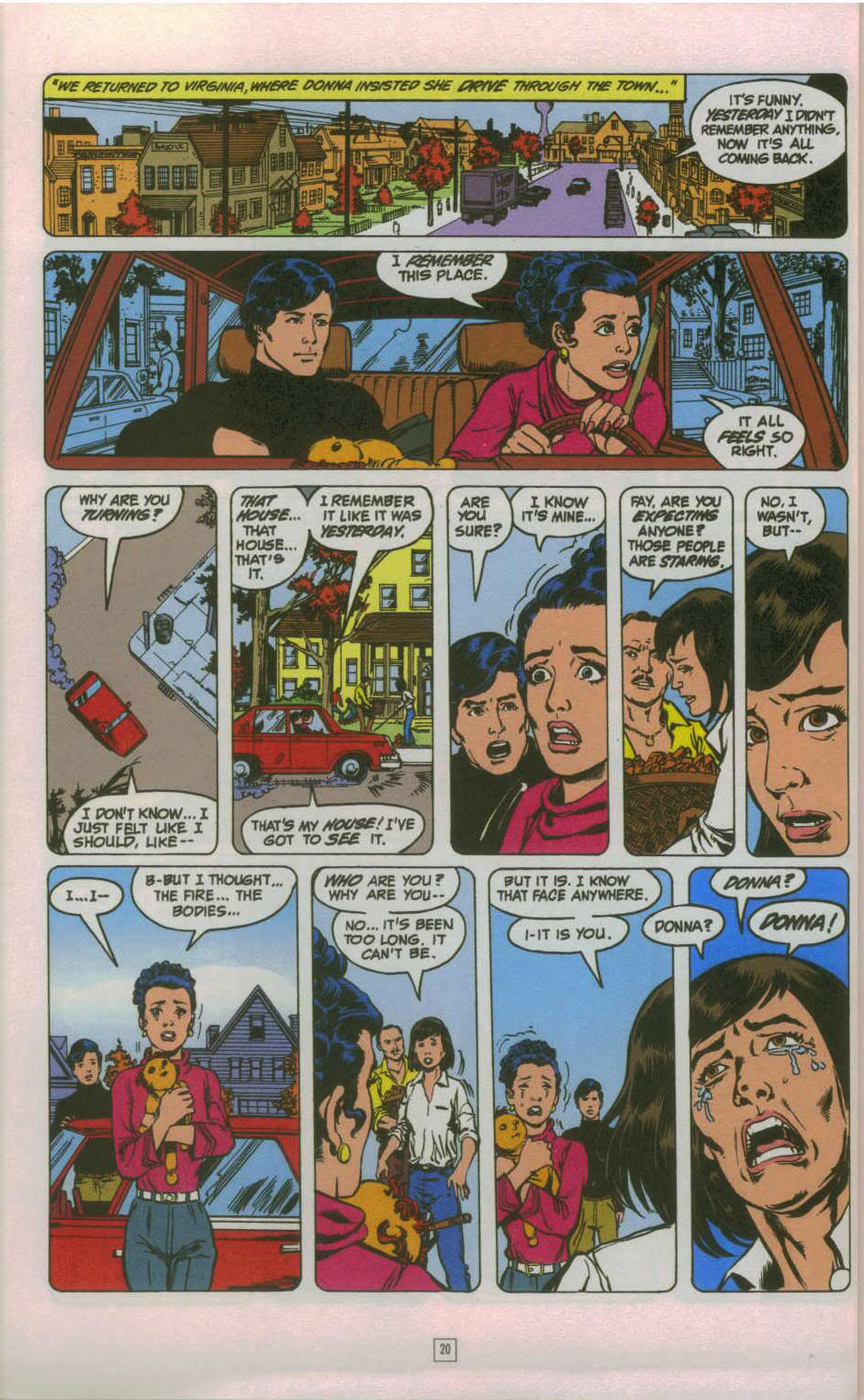
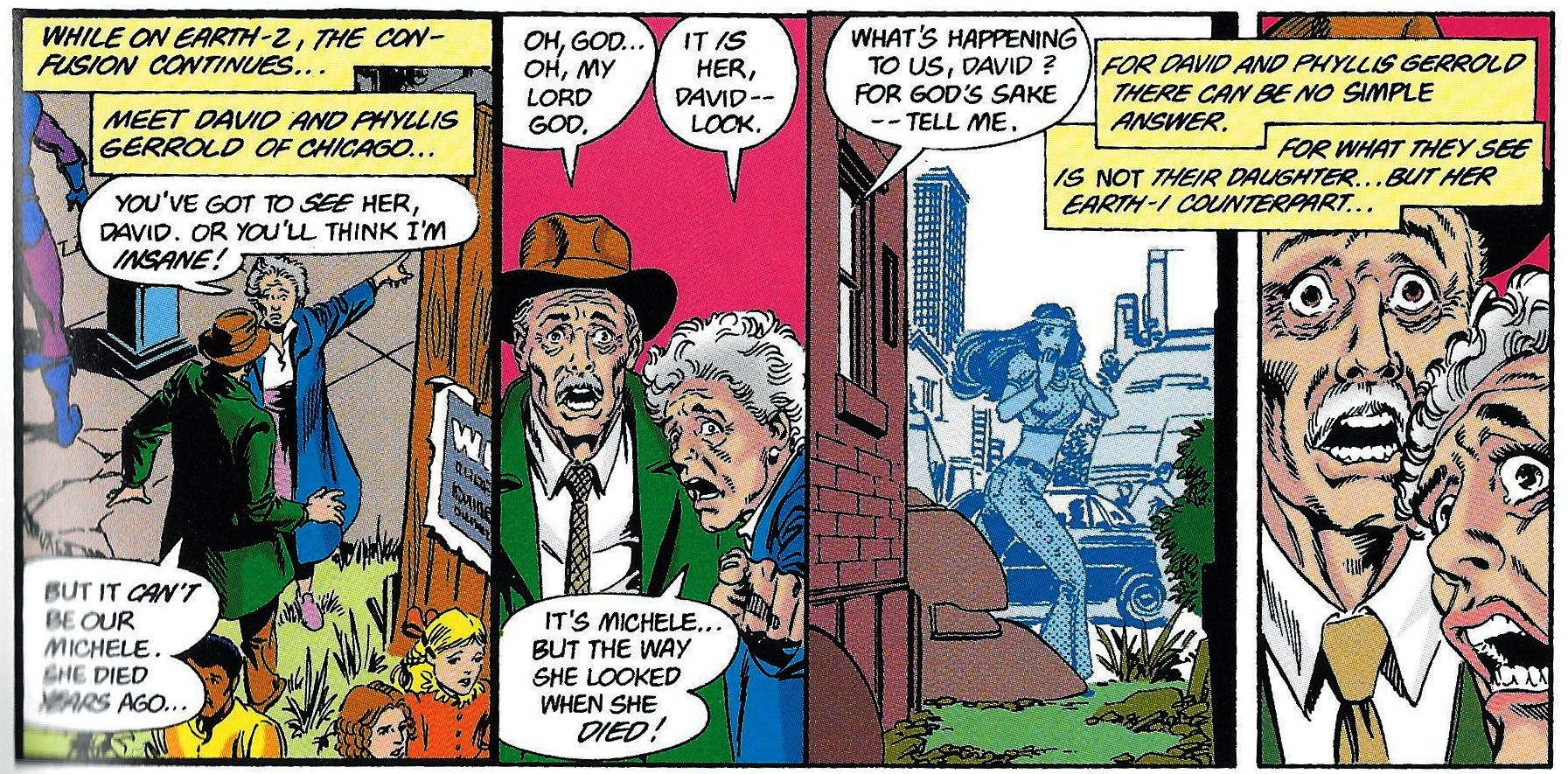
Below are scans of the ten moments I talk about, in brief, in the episode (btw, some of these are spoilers for the stories they are from).

1. Batman Confronts Silver St. Cloud (Detective Comics #475):

Silver St Cloud2. Donna Troy Reunites With Her Adopted Mother (The New Teen Titans [First Series] #38):

Donna Troy Reunion3. Ordinary Citizens Reacting to Merging Earths (Crisis on Infinite Earths #5):

Crisis 5 Old Couple4. Bruce Wayne Has Some Bad News (Detective Comics #620):

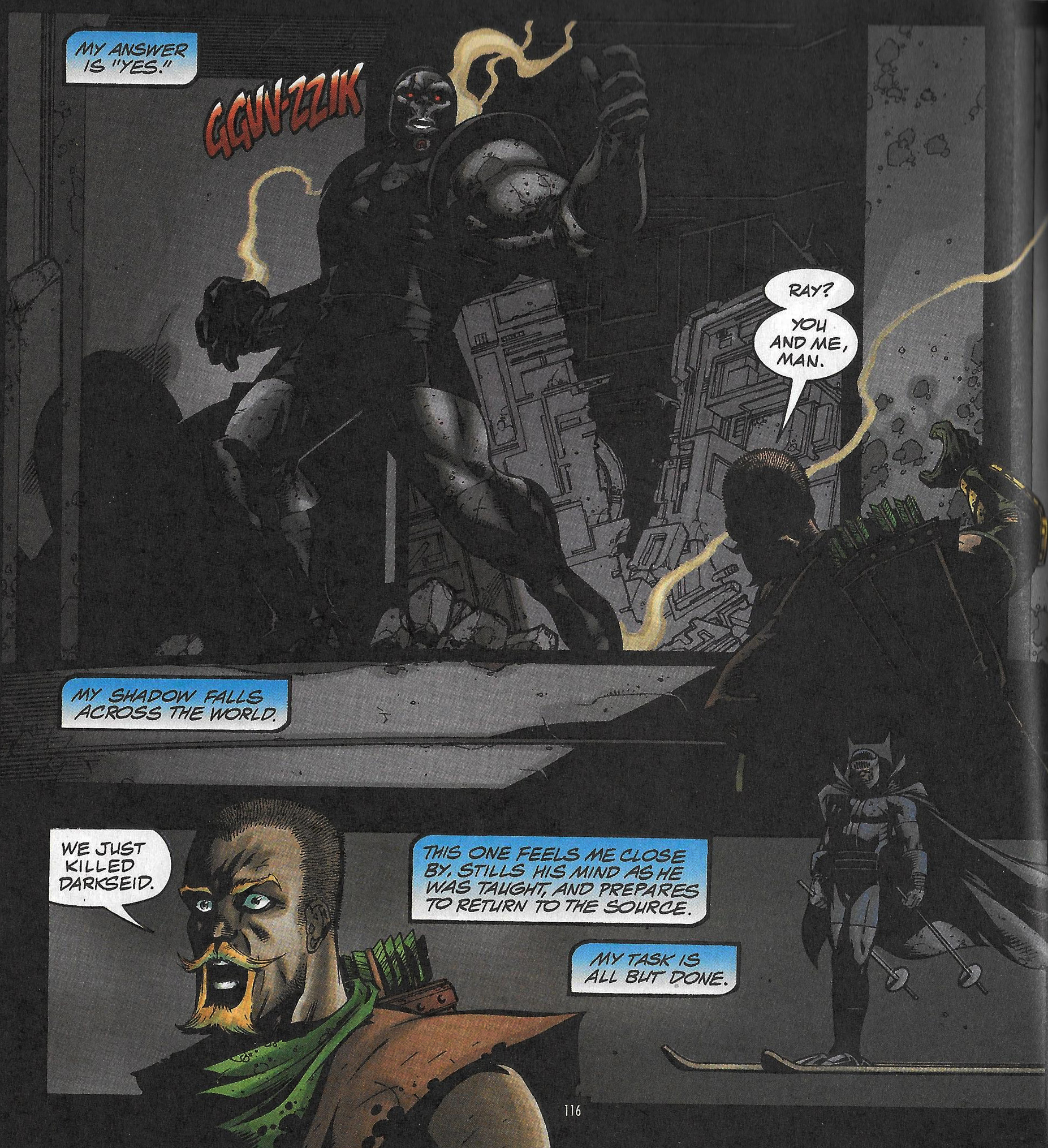
Detective 620 Last page5. The Atom and Green Arrow Kill Darkseid (JLA #14):

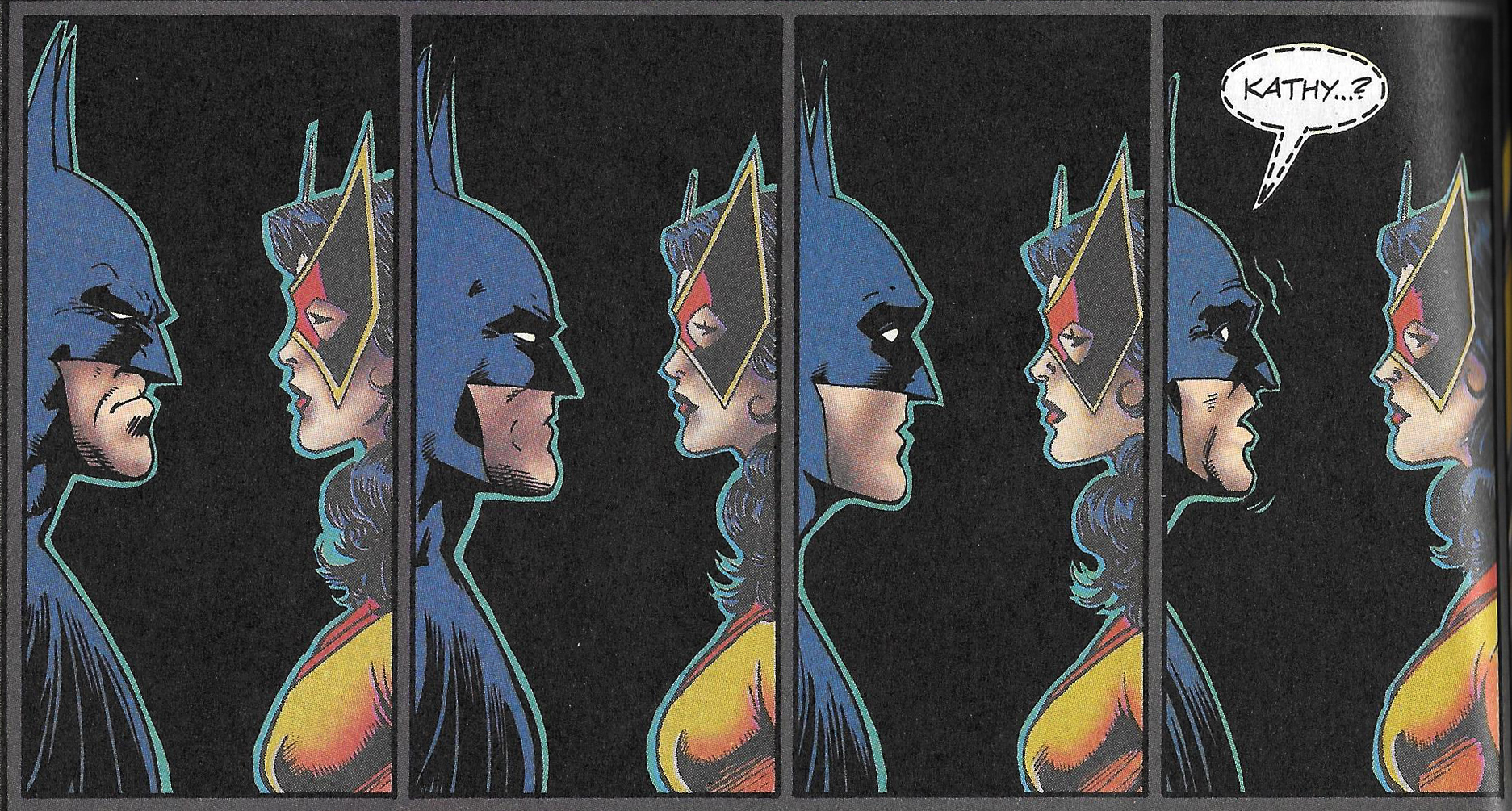
JLA Death of Darkseid6. Batman meets … Batwoman? (The Kingdom:  Planet Krypton):

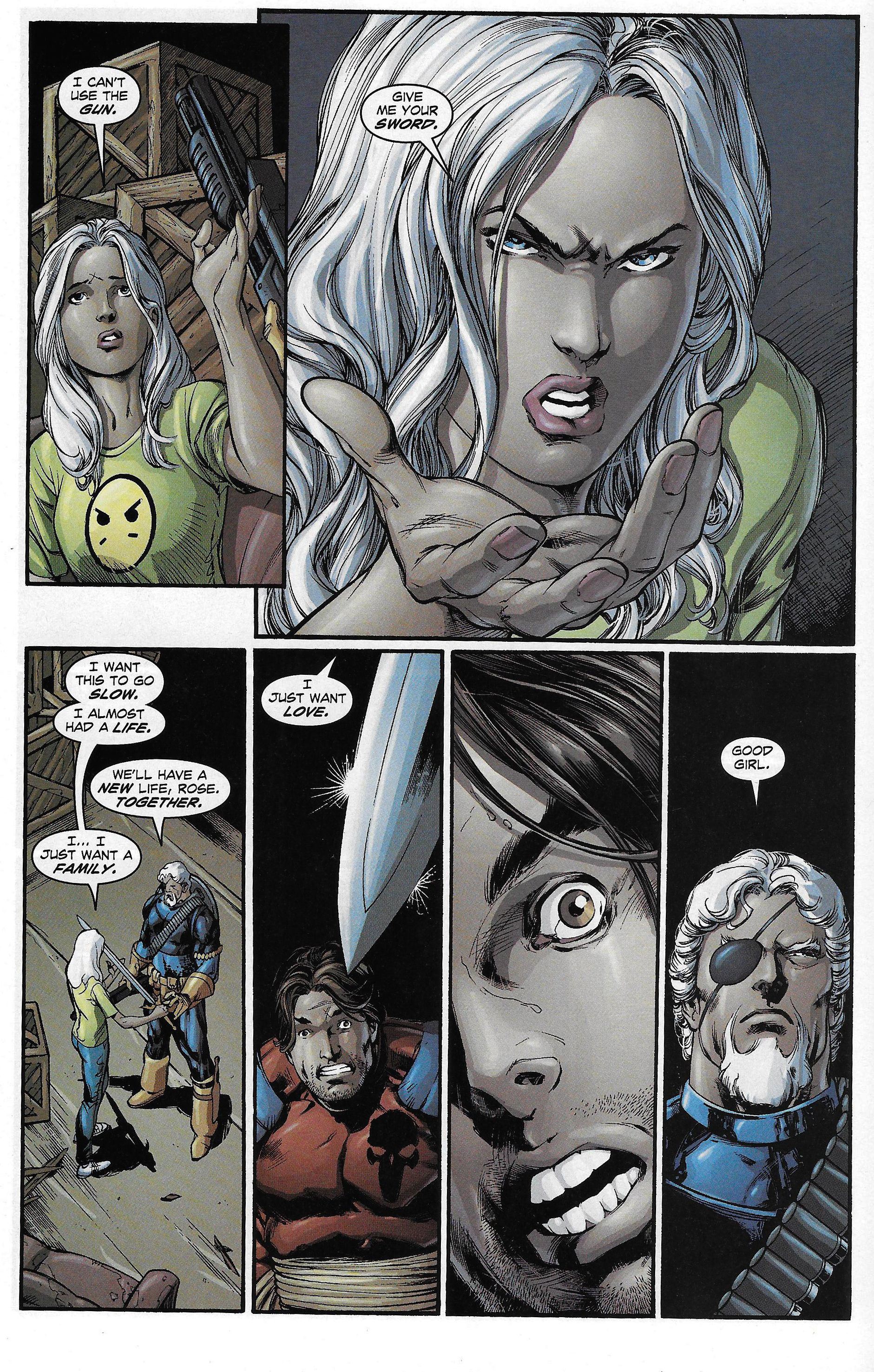
The Kingdom Batwoman7. Rose Wilson Chooses Her Family (Teen Titans #1/2):

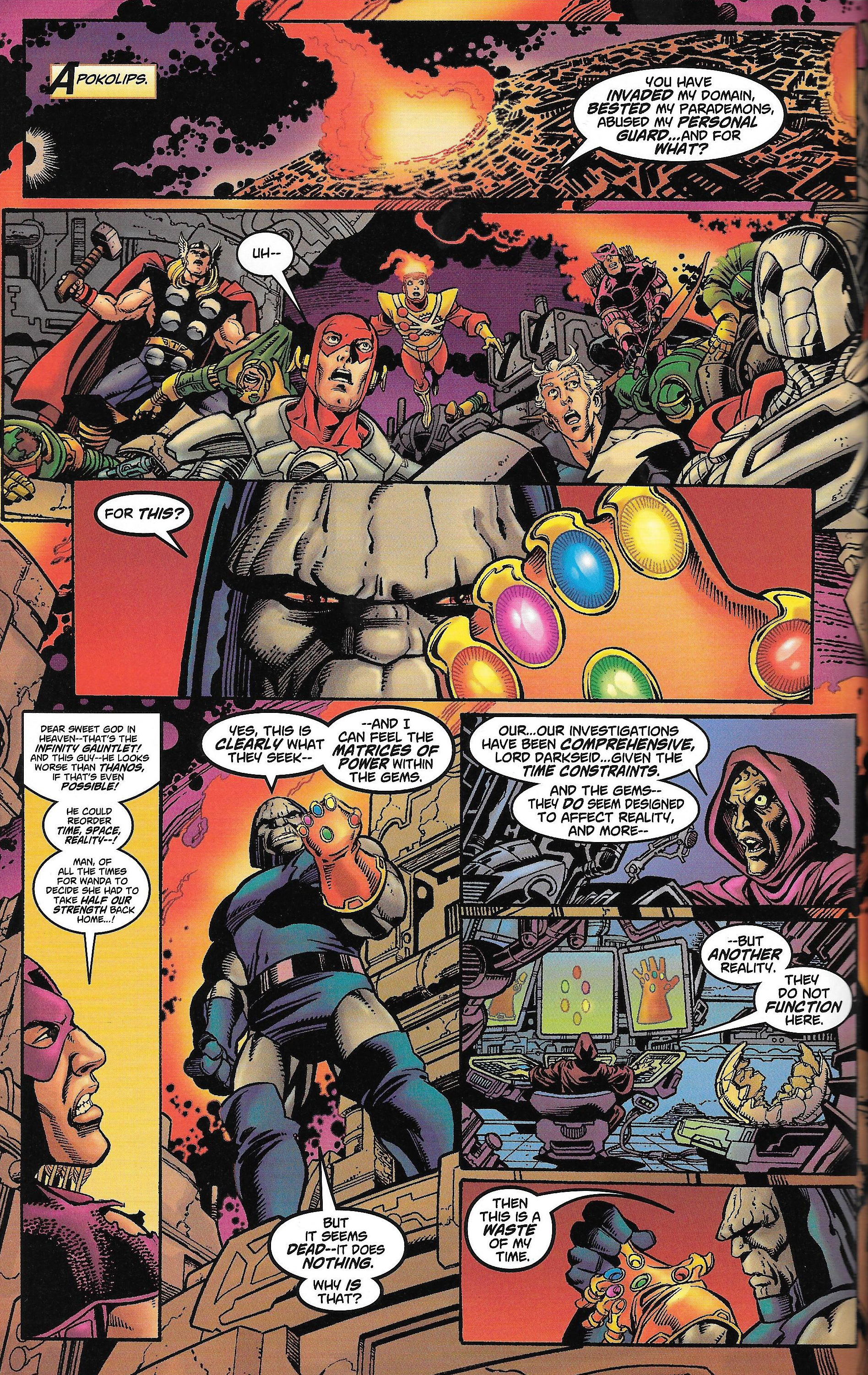
Rose Wilson Ravager8. Darkseid and The Infinity Gauntlet (JLA/Avengers #2):

Darkseid JLA Avengers9. “Superheroes.  Kill.”  (Final Crisis #3):

Final Crisis 3 final page10.  Danny Chase’s Sacrifice (The New Teen Titans: Games)

Teen Titans Games Danny Chase

O Say Does That Star-Spangled Banner Yet Wave; This Concludes Our Broadcast Day

JeffersonThis weekend marks the bicentennial of Francis Scott Key’s writing “The Star-Spangled Banner.”  To mark the occasion, Baltimore had a large celebration in its harbor, especially near Fort McHenry, which is where Key was being held prisoner during the Battle of Baltimore.  The history of our national anthem goes beyond that one battle of the War of 1812 and  The Washington Post has a really great article that discusses that history (“5 Myths About the National Anthem”).  I actually knew a majority of the truths the writer discusses because of a filmstrip I saw in music class when I was in the fifth or sixth grade.  Don’t ask me how I actually retained that information and not, say, trigonometry, because it’s one of the great mysteries of life.

But I didn’t want to write this short post about the history of “The Star-Spangled Banner” or discuss its significance in our everyday lives as Americans.  No, this blog is about popular culture and when I, and quite a number of people older than myself, think of the national anthem’s place in popular culture, they might think of this:

If you’re under a certain age, you may not know what the significance of the clip I just posted because you might also not be familiar with the concept of a station signing off.  In the days before hundreds of channels and all-night infomercials, local television stations and network affiliates signed off for the night, concluding their broadcast day with a pre-packaged video montage and then going to some sort of test pattern with a constant high-pitched tone:

One of the most common sign-offs was the playing of “The Star-Spangled Banner” (something so common it opens Billy Joel’s song “Sleeping With the Television On”). There were quite a number of different versions of the national anthem sign-off, but this one always stuck out to me as one of the more memorable, probably because it was one of the few I actually saw–although if I’m being truthful, it may have been used as an early morning sign-on as well.

The montage I posted was created by the New York-based firm Saxton Graphics Associates, Ltd., probably in the early 1970s (since it closes with the moon landing) but I couldn’t find much else in the way of history of the montage beyond this paragraph on the Wikipedia page for “Performances of ‘The Star-Spangled Banner'”:

Over the early years of U.S. television broadcasts it became common practice by many stations to close their broadcast day, usually late at night or early in the mornings, by airing the Star Spangled Banner accompanied by some visual image of the flag or some patriotic theme. One audio-visual arrangement in particular, entitled “National Anthem,” [5] was produced by a New York-based graphics firm, Saxton Graphic Associates, Ltd. The uncommonly complex and interesting orchestral arrangement of the Star Spangled Banner commences with a trumpet fanfare then the anthem is accompanied by images that illustrate several of the highlights of the history of the United States of America, culminating with an image from 1969 of an Apollo 11 astronaut standing on the Moon by the US flag. Several television stations aired this including WNEW-TV in New York (through 1978), and Washington DC WDVM-TV channel 9. There is no reference to whom arranged the music, nor to what orchestra performed it though numerous sites on the Internet host messages inquiring about this and where the original music might be found today.


I don’t have a long, drawn-out nostalgic story for this one.  It does remind me of the times when I had to stay at my grandmother’s house and we’d get to stay up late for, say, New Year’s Eve or something, and it kind of reminds me of flipping around the channels in the very early hours of the morning when I had my first job of putting Sunday papers together at a local stationery store.  But when I watch it now, it actually is a little moving.  I’ve always loved how the montage takes us through all of American history and reminds us just how much has happened in the last 200-300 years; furthermore, the bombastic arrangement of the song is enough to get even the most cold-hearted cynic (read: me) feeling at least slightly patriotic.  And it’s a memento of an earlier time in our country’s media history, a piece of ephemera that makes some wistful for an earlier time and others curious.

Bottom of the Inning: Taking Baseball Personally (Baseball, Part Two)

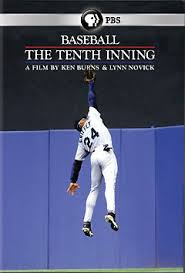
Baseball 10thIn my last post, I mentioned that watching all of Baseball made me feel like I was in an introductory, or “101” class on the game.  As well-researched and well-crafted as Ken Burns’s documentary was, there were times where I felt like I was getting the history textbook version of the baseball story:  hit the high points, go selectively in-depth, and completely skip over quite a bit.

While that’s a valid criticism, leaving it at that would be giving the work short shrift, especially since it’s a full day’s worth of a documentary.  Furthermore, I spent much of that first part of my look at Baseball on summary and critique and didn’t give much of my personal “story” as it is, or at least my personal reactions while I was watching it.  Which is kind of the whole purpose of this blog, right?

So that’s what I’m going to do.  Inning by inning.

First Inning (“Our Game” 1850s-1900):  This isn’t Baseball, this is seventh grade social studies with Mr. Kerkhof.  We’re talking about the Antebellum period and …  man, the 1800s are boring.  But this?  This isn’t so much because it’s an origin story, the kind I’m fixated on whenever we begin looking at an important event.  What were the first shots fired in the Revolutionary War and how did it progress from there?  Who actually founded the Roman Empire?  When did the  Middle Ages officially begin?  Who played that first game of baseball and what was it like in what seems like the Dark Ages to me–before Ruth, Gehrig, Mays, Mantle, and every other name I know?

Second Inning (“Something Like a War” 1900-1910):  I’m ten years old and my parents have given me a “Baseball’s All-Time Greats” baseball card set, the one I spotted in the Sears catalogue.  There’s Ty Cobb, and there’s Honus Wagner, who has the most expensive baseball card in existence, something I learned on a feature I saw on 20/20 the previous year.  I begin looking at the all-time stats for the old players and am amazed and even though many of their records have been broken, they still are in the top five for many of their most notable categories.  The card set is worth original retail price (and even today it’s not worth much), but what it lacks in monetary value it more than makes up for in facts.

Third Inning (“The Faith of Fifty Million People” 1910-1920):  To me, it’s not the Black Sox scandal; it’s Eight Men Out and Field of Dreams.  It’s “Say it ain’t so, Joe,” and the last scene of that softball episode of Married … With Children that parodies the last scene of Eight Men Out.  It’s also the idea that even something as pure as a game I play on Saturday mornings in Little League can be corrupted by outside influences (yunno, beyond the opposing team’s coach being friends with the umpire).

Fourth Inning (“A National Heirloom” 1920-1930):  I’m in the fifth grade and we’re asked to take a biography out of the library for our latest book report/conference with the teacher.  I grab one about Babe Ruth.  He competes with Gehrig.  He is supposedly “stranger than fiction,” which is what one of the chapter titles says.  Despite my being an excellent reader, I have trouble getting through the entire book.  I don’t know if it’s because the book’s badly written or because I don’t find the subject matter as interesting as I thought I would.  In fact, I can’t remember if I ever finished that book.  I do know that when I had my conference with Mr. Schafer about it, I did fine.

Fifth Inning (“Shadow Ball” 1930-1940):  I have no personal context for this.  In fact, if there is any episode that I found myself glued to, it’s this one.  Growing up, my knowledge of the struggle of African-Americans was limited to slavery, Plessy v. Ferguson, Brown v. Board of Education, and Martin Luther King Jr.  I was not exactly a scholar.  I knew the Negro Leagues existed but I don’t think that what little I read about them in books clued me in to what extent.  If anything, I’m grateful for what I gained from this episode.

Sixth Inning (“The National Pastime” 1940-1950):  It’s 2012 and I’m in a used bookstore on the Downtown Mall.  I’m looking for a copy of As You Like It but am also perusing the small graphic novel section.  On my way to the counter, I pass sports and Roger Kahn’s The Boys of Summer.  It sits on my shelf until the start of the 2013 season rolls around.  While Kahn’s biographical retelling of his time becoming a sportswriter is interesting, it’s his visits with former Dodger greats and the retelling of Jackie Robinson’s history that pulls me in.  For years, I knew three things about Robinson:  he played for the Dodgers, he broke the color barrier, and he stole home once in the World Series.  This tells me so much more.

Seventh Inning (“The Capital of Baseball” 1950-1960): I’m twelve years old and my family is throwing one of those big barbecues where everyone–from my mom’s side and dad’s side–is there.  My Uncle Brian, a die-hard Yankees fan, spends a good hour talking to Grandpa Panarese about baseball in the 1950’s.  They talk about the Yankees, the Giants, and the Dodgers.  I don’t interject; I just listen.  It’s one of the best memories I have of these two men and one of the most informative conversations upon which I ever eavesdrop.

Eighth Inning (“A Whole New Ballgame” 1960-1970):  To me, this is where baseball begins; specifically, in 1962, when the New York Mets go 40-120 and set an all-time single-season loss record that still stands.  I cut my baseball history teeth on An Amazin’ Era in 1986 and to me, “baseball history” has always involved Seaver, Koosman, Swoboda, Clendenon, Agee, Grote, Garrett, and McGraw.  Yes, there are more important figures in baseball history and more important events.  But it’s the lovable losers’ transformation into the Miracle Mets that I always remember.

Ninth Inning (“Home” 1970-1993):  It’s fascinating to see Bob Costas tell the story of being in the Red Sox locker room during the Buckner play and watching the champagne get wheeled out as quickly as possible.  It’s also fascinating to see testimony from Red Sox fans who were wounded by the play.  After all, I rooted for “the enemy” in 1986.  My nine-year-old dreams came true when Jesse Orosco threw the last pitch to Marty Barrett (I have a poster on the wall of my classroom), so it never occurred to me that someone might be upset by that night’s events.  Beyond that, there are so many recognizable faces here and I wish he was taking more time on them; I wish he was reminiscing with me the way he was reminiscing with my parents through the seventh inning.

When it ends with a talk about how baseball endures I realize that this isn’t a documentary; it’s a eulogy.  The season was cancelled due to a strike the month before the first episode aired and it doesn’t seem like we’ll get the game back.  Furthermore, it’s hard to pick a side because everyone seems greedy; everyone seems like a villain.  And here, at the funeral, we’re all trying to remember why we came.

Tenth Inning (1994-2010):  I was there.  I remember that.  I watched that.

I will never tire of watching Barry Bonds fail to throw out Sid Bream.  I always loved how much fun Ken Griffey Jr. seemed to be having–and always wished I had that swing.  I was cheering for McGwire the whole time and have to admit I was disappointed when the PED charges came to light.  I never cheered for Bonds unless he struck out looking.  I want to buy Steve Bartman a beer and talk baseball with the guy–not that game, just baseball.  No, the 2004 ALCS is not overrated and yes, I’ll watch the Yankees choke like that any time, day or night.  My heart was in my throat when Endy Chavez made that catch, only to have the Cardinals rip it out and crush it a few innings later.  You’re really using that Springsteen song, Ken?  Don’t you realize it’s about looking back and realizing how middle-aged you are?

“But then time slips away and leaves you with nothing mister but boring stories of glory days.”

You know what?  That’s exactly what this is, isn’t it?  Good job, sir.
Now the world don’t move to the beat of just one drum.

drummondWhile I know that it didn’t get the attention of the deaths of Dear Abby, Stan Musial, or Earl Weaver last week, I have to admit that I felt a little sad when I saw the obituary for Conrad Bain in the New York Times.  A Canadian-born actor with quite the lengthy resume, Bain was a mainstay of television in my childhood ecause of his role as Mr. Drummond on Diff’rentStrokes.

A sitcom that began airing in 1978, Diff’rent Strokes lasted until 1986 and aired mostly on NBC (with the 1985-1986 season airing on ABC) and was the story of two black kids from The Bronx who were adopted by a Park Avenue millionaire.  It’s an odd concept for a show and one I swear only would have worked in the 1970s, but I didn’t think anything of that when I was six years old and allowed to stay up on Saturday nights to watch it (and sometimes Silver Spoons, which came on at 8:30).  This was a big deal for a kid whose bedtime was 8:00 on the weekdays and I remember loving the show so much that I tape recorded (like literally sat a tape recorder next to the television and hit “record”) the 1984 hour-long “Mr. Drummond gets married” episode.

I’m not sure if I watched it on Saturday nights beyond that, because my memory is hazy and I always associate Saturday night television viewing with The Facts of Life (briefly, anyway), and The Golden Girls (which dominated NBC Saturday nights for years), but that doesn’t matter because the show was a rerun mainstay all the way up until I was in my first year or so of high school.  WNYW, New York’s Fox affiliate (channel 5) ran Diff’rent Strokes at 5:00 p.m. and The Facts of Life at 5:30 p.m. through much of the latter part of my elementary school career, concluding it sometime when I was in junior high (what it was replaced with I don’t remember, although eventually Fox 5 ran The Simpsons, Seinfeld, and Friends).  Since I didn’t have cable at the time, that meant I would come home, turn on the television, and at 5:00, after cartoons were done, I would see a familiar shot of the east side and hear Alan Thicke’s lyrics:  “Now the world don’t move to the beat of just one drum …”  Then, it would be Arnold, Willis, Kimberly (unless it was one of the seasons where Dana Plato had been fired for being knocked up and using drugs), Sam (whose mushroom haircut I hated), and Mr. Drummond.

Bain played Mr. Drummond like a typical sitcom father, imparting some of the show’s lessons like Robert Reed did on The Brady Bunch (a show that I remember seeing for the first time at an incredibly early age and much like Diff’rent Strokes always seemed to be on) and making some lame attempt at a joke every once in a while.  He wasn’t the type of sitcom father whom you felt was “your father” or a ‘dad”; he was just … well, there, the mainstay of a show whose cast was full of problems (though I honestly didn’t know that until years later).  In fact, I don’t remember Mr. Drummond being much of a factor in most of the episodes, especially the two most memorable ones–the Nancy Reagan anti-drug epsiode, and the two-parter about sexual molestation where Gordon Jump plays the bike shop owner (though Mr. Drummond does call the authorities and is the “moral voice” throughout).  He did, however, have a couple of episodes that stood out.

Aside from his romancing Maggie (first played by Dixie Carter and then Mary Ann Mobley, who replaced Carter after NBC canceled the show and Carter went to Designing Women), there was the time Mr. Drummond came home with his neck all cramped from stress and the family discovered that Willis had severe stress and had to learn to balance the activities in his life.  There was the “Undercover Boss” episode where Mr. Drummond works at one of his company’s factories to see what it’s like to work there and challenges the entire family to “live blue collar,” which for Arnold means wearing a Van Halen T-shirt because that’s what poor people do or something.

And of course, there was the two-parter where Sam was kidnapped and at some point, Drummond had some fisticuffs with a possible kidnapper, a scene that I remember prompted my friend Harris and I to come up with the idea for a fake movie:  “Conrad Bain is X-CUTIONER 3000.”  Yeah, I don’t know why Mr. Drummond as Charles Bronson in Death Wish was so hilarious but when you’re 13, you find some of the most random crap funny, I guess.  Besides, when I told him about Bain’s death the other day, he replied, “Bonar Lives!” in reference to Conrad Bain’s twin brother Bonar, something we also found funny at 13 (and I’m amazed that I never wrote BONAR LIVES! across the front of my notebook as if it were “Save Ferris”).

Anyway, there’s only five cast members left alive from Diff’rent Strokes:  Todd Bridges (Willis, who had his share of substance abuse issues but has been clean for about 20 years), Danny Cooksey (Sam, who has a decent-sized voice-over resume and was in Terminator 2 as John Connor’s mulleted friend), Mary Ann Mobley (the second Maggie), Mary Jo Catlett (Pearl, the third maid, who now provides the voice of Mrs. Puff on SpongeBob SquarePants), and Charlotte Rae (Mrs. Garrett, who will outlive them all).  And I’d like to say that the show taught me so much, but like Mr. Drummond, I think I watched it because it was simply always there.