 If you were a comics reader in the late Eighties and early Nineties, you probably saw their ads–either a long list of back issues against a yellow background or a striking picture of the latest HOT character advertising what was going to be a RED HOT book. Well in this episode, I’m joined by Michael Bailey of Views From the Longbox (among other podcasts) for the first part of a two-part crossover about collecting comics in the decade that subtlety forgot.
For part one, Mike and I spend time talking about being teenagers during the boom years and specifically look at buying back issues through the mail. We talk about our experiences with Mile High Comics, the stalwart mail order service that so many of us have dealt with or bought from at one point or another. Then, we answer a question that crosses the minds of comics fans whenever they’re flipping through some Nineties comics: Whatever happened to American Comics/Entertainment This Month?
And after you’re done with that, check out Episode 233 of Views from the Longbox, which will drop later this week, where Mike and I continue our discussion, this time turning our attention to Wizard: The Guide to Comics. It’s the most EXTREEEEEEEEEME two-parter EVER!
Oh, and special thanks to Andrew Leyland, who really should be getting some sort of royalty check from me … but isn’t.
Here’s where to listen:
iTunes: Pop Culture Affidavit
Direct Download
Pop Culture Affidavit podcast page
As an added bonus, here are some images and links that I used as part of my research for the episode:
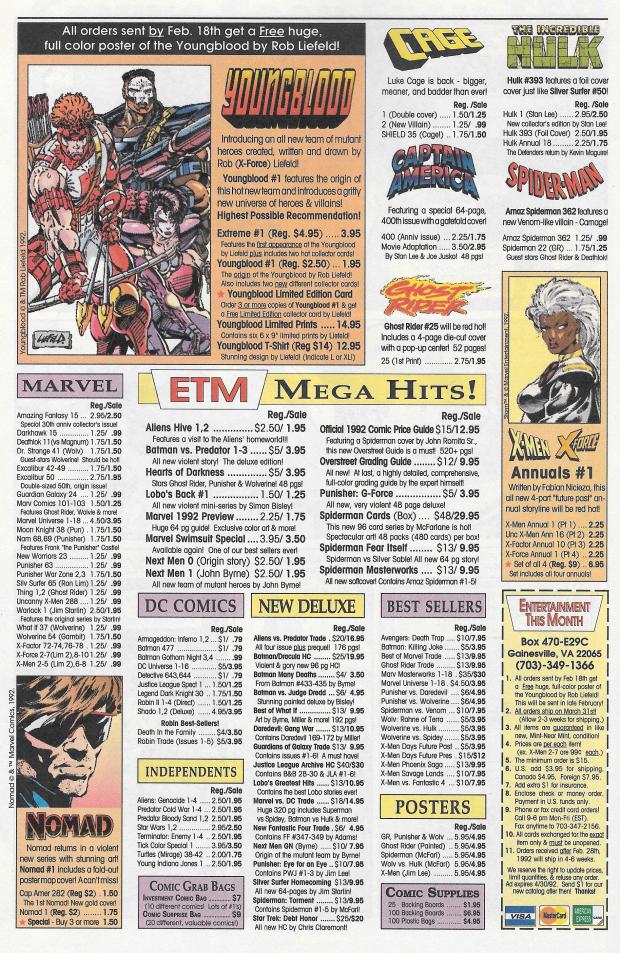
An Entertainment This Month ad (taken from an issue of The ‘Nam from 1992):
The 1986 article from The Cavalier Daily (UVa’s student newspaper) about American Comics’ founder, Steve Milo: “Comics: America’s Hottest Art”
An Entertainment This Month Ad featured on the blog Very Fine Near Mint: “Entertainment This Month, Spider-Man Ad, 1990”
A Washington Post article from 1991 about the growing boom in the comic book retail industry: “Racking Up Sales of Comic Books”
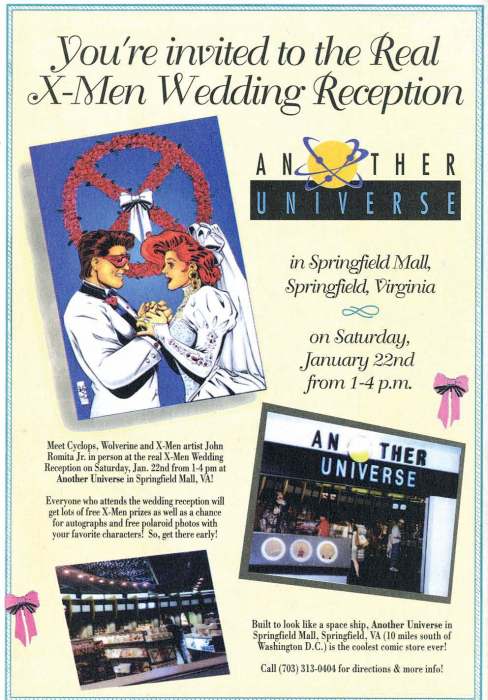
An ad for a Scott Summers/Jean Grey wedding event to be held at Another Universe in the Springfield Mall in Springfield, VA (Another Universe was the company that American Entertainment was eventually purchased by in the mid-1990s):
The thread that I pulled the above ad from on the board Fairfax Underground: “Anybody remember that Another Universe store in Springfield Mall?”
The FTC press release concerning the settlement with American Entertainment/Entertainment This Month: “American Distribution, Inc.”
A Comic Book Resources article about Steve Milo being named head of new media for Marvel: “Marvel names AU founder Steve Milo president of new media”
And various boards and websites that tracked or made announcements of the gradual demise of Another Universe/Mania.com (an online venture Milo started in the late 1990s), which include speculation that the business was being sold to Steve Geppi:
“Mania Healthy, Publisher Says” (adamarnold.net, September 1998)
Ramblings — 29th October 1998 by Rich Johnston (Bleeding Cool)
“Another Universe.com Bites The Dust” (gamegrene.com,February 2001)
Finally, as an added bonus, here is an incredibly interesting read that wasn’t used for this episode but was intriguing nonetheless. Collected from a series of message board posts (which, unfortunately, end abruptly) and published in 2005 on a site called badmouth.net, this is the story of someone who had a small comic/card show-based retail business in the early 1990s and saw it all completely go up and way, way down in front of his very eyes: “The Comic-Book Apocalypse”
 War comics legend Russ Heath joins regular writer Chuck Dixon for a story about Ice and Speed tracking a ruthless VC sniper known as The Ghost. It’s all in The ‘Nam #65, “The Gratitude of His People.” As always, I take a complete look at the issue and this time around I’ll be looking at June 1971.
 It’s the conclusion of a three-part story featuring Iceman and Speed in “Duty Elsewhere” from The ‘Nam #64 by Chuck Dixon, Wayne Vansant, and Art Nichols. Plus, I take a look at the history of the Vietnam War in April and May 1971.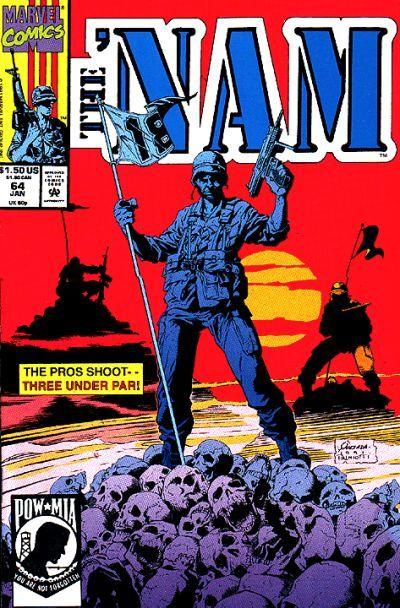
 After a brief hiatus, “In Country” is back and back in The ‘Nam with issue #63. We continue our three-parter featuring Iceman and Speed with a story by Chuck Dixon that features art by Wayne Vansant and Kim DeMulder. Plus, I look at events from March 1971 and read listener feedback!
 “Dirty Deeds” brings us the return of two characters from previous ‘Nam missions: Speed and Iceman. Here, they are sent to retrieve an LRRP soldier who has gone rogue while back in Da Nang, the girlfriend of one of their special forces’ team gets into some serious trouble. It’s all in The ‘Nam #62 by Chuck Dixon, Wayne Vansant and Kim DeMulder.
 This time around, we close out the three-issue POW storyline with “The Ville,” a story by Chuck Dixon, Wayne Vansant, and Nicholas James that sees what happened to Ritchey when he escaped the POW camp. Will he make it out of the jungle alive? Or will he get caught and sentenced to an even worse fate? Find out in The ‘Nam #61.
 We are back to regular coverage with The ‘Nam #59, a story called “Buff Strike” that starts as a look at the crew of a B-52 and ends up being a POW story. It’s brought to us by Chuck Dixon, Wayne Vansant, and Kim DeMulder.
 I’ve written before about how my junior high school years were incredibly awkward and not the fondest when it comes to my social life, but when I think about it, my choices in after-school entertainment were just as awkward. I was in on the verge of being a teenager, but I was still coming home to watch cartoons on television or playing NES; conversely, I was also watching sitcom reruns and Degrassi High. Which is how, in March of 1990, I discovered Tribes.
 We reach the conclusion to “The Death of Joe Hallen” with “Down So Long …” in The ‘Nam #58, a story written by Chuck Dixon with art by Wayne Vansant and Tony DeZuniga as well as a cover with metallic silver ink by Andy Kubert (it’s about as Nineties as The ‘Nam will get, kids … at least as far as the covers go). Also in this episode, I wrap up the historical context for the year 1969 with a look at December.
 It’s time for YET ANOTHER PLAYLIST EPISODE! Inspired by Andrew Leyland’s movie scores episode of “The Palace of Glittering Delights,” I’ve compiled a playlist of songs from movie soundtracks that are both classic and obscure but are in many ways spectacular. I’ve got Simon & Garfunkel, The Bee Gees, Queen, Irene Cara, and (of course) Kenny Loggins. So many movie memories! So many songs left off the list!
