television

Pop Culture Affidavit, Episode 33 — There Was This TV Show …

Episode 33 CoverTwenty years ago, a television show premiered that, while it lasted only one season, had a clear impact on its devoted fans.  The show was My So-Called Life.  In honor of its twentieth anniversary and its place in 1994: The Most Important Year of the Nineties, here’s the first of two episodes.  In this one, I give my so-called origin story and take a look at each episode.

You can listen here:

iTunes:  Pop Culture Affidavit

Direct Download 

Pop Culture Affidavit podcast page

Boldy Went

Star_Trek_GenerationsEarlier this year, I sat down with Michael Bailey and talked about the comic books of 1994.  He talked about how this was a landmark year for him as a comic collector because it was the year that the greater DC Universe opened up to him.  I actually remember it as being a bit of the opposite.  I didn’t stop collecting comics or anything, but I did find myself becoming more discerning as a comic book reader and collector.  As I’ve thought about 1994 and its importance in the decade, I’ve come to realize that this also applies to Star Trek.

I was a pretty big Star Trek fan from the time I was about nine years old and saw Star Trek IV: The Voyage Home for the first time in the movie theater and through most of junior high and the first year or two of high school.  Being a fan of Trek wasn’t exactly popular at the time and I definitely took a fair amount of shit, but I seemed to take a fair amount of shit for simply breathing when I was in the eighth grade, so whatever.

Anyway, 1994 is a landmark year in Trek because it marked the end of Star Trek: The Next Generation, the show that really cemented the concept of Star Trek as a show with a legacy beyond a 1960s television show and a series of popular movies starring the same group of people.  I had been kind of cold to the show when it premiered in 1987 because I was huge fan of original series reruns and original series movies, but it grew on me.  I never found myself watching it on a regular basis, but I do remember streaks of several weeks in a row because one episode hooked me in (my all-time favorite is the two-part cliffhanger “The Best of Both Worlds”).

“All Good Things,” which was the final episode of ST:TNG, aired on May 23, 1994 and being in the New York area, that was on WPIX at either 7:00 or 8:00 on a Saturday night.  I missed the original airing because I had to go to some family party, so I programmed the ancient top-loading Panasonic VCR in our basement to tape it when I got home.  For whatever reason–probably user error–it didn’t tape.  I was bummed but apparently not bummed enough to try and find a rerun because I didn’t actually see “All Good Things” until about 2009 or 2010 when I found it randomly on cable one night.

But the Trek faithful didn’t have too much to be upset about that year when it came to losing their favorite show.  Star Trek: Deep Space Nine was still on the air (although I admittedly didn’t watch it) and that November, Star Trek: Generations hit theaters.  This was a movie that was set up to be a pretty big deal–Kirk and Picard were going to be on screen together.  There was time travel involved, of course, but it was going to be huge.

I missed this in the theater and when I eventually saw it on video, I was kind of glad I did.  Star Trek: Generations is not that great of a movie.  It’s not Star Trek V horrible by any means, but it definitely follows the pattern of odd-numbered Trek movies being “meh.”  Granted, I haven’t watched it in two decades so I may be wrong, and that’s why I’m not going in-depth with a review of it or offering up a podcast episode.

What strikes me, though, when thinking about this, was how it was one of the first times where I hit a point that I definitely could say that I was at the end of my fandom of something.  It’s not that I stopped liking Star Trek by any means–in fact, I went and saw First Contact in the theater (and thought it was pretty good)–it’s that I was no longer so attached to it.  And really, I wasn’t used to that.  Since then, it’s happened with several things from bands like Metallica to comics like Batman, but Trek was the first “living” thing that I could turn to and feel a specific nostalgia for (as opposed to long-dead cartoons like Voltron, for instance), as if it reminded me of a place, time, and attitude that was no longer there.

Oh, and I still think Kirk’s death was cheap.

Pop Culture Affidavit, Episode 31 — The 1994 Grab Bag!

man reaching into grab bagWhat do Beverly Hills, 90210, the 1994 Baseball Strike, and Zima all have in common?  They’re all covered in the latest episode of Pop Culture Affidavit!  As part of my series of posts and episodes called 1994: The Most Important Year of the Nineties, I take a look at ten completely random things from 1994.  It’s movies, television, music, and current events all in one convenient episode!

You can listen here:

iTunes:  Pop Culture Affidavit

Direct Download 

Pop Culture Affidavit podcast page

(more…)

Top of the Inning: The 101 Course (Baseball, Part One)

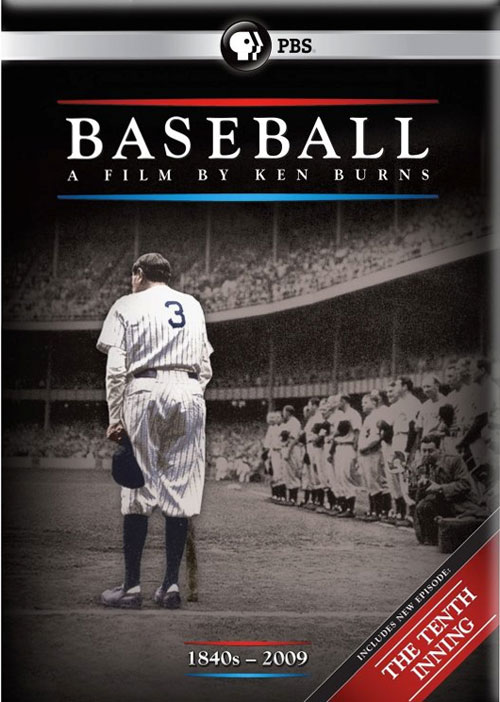
Baseball DVDThis post and the next post is part of the Big League Blog-a-thon, coordinated by Forgotten Films, home to one of the best film podcasts out there, The Forgotten Filmcast, which is about the movies that time forgot.

I discovered early on, after volunteering to sit down and watch Ken Burns’ documentary, Baseball, that one simply does not sit down and watch Ken Burns’ Baseball. No, it is something that taunts you from the screen of your Netflix queue, daring you to take it on like a pitcher who’s been throwing heat all night and has only just hit his stride.  And all you can do, really, is step up to the plate, bear down, and let him know that if he’s going to get you out, you’re going to have to work for it.

In other words, challenge accepted.

Bad metaphors and even worse Barney Stinson jokes aside, Baseball was something I had watched when it was originally on back in 1994 but didn’t remember much about except that Burns spent the segment about the 1986 Mets talking about the agony of the 1986 Red Sox and that he must have exhausted every available version of “Take Me Out to the Ballgame” over the course of the documentary.  That I remember the former should not be a surprise–my Mets fandom runs deep, even when they lose–and after re-watching all ten innings, the latter still rings true.

Baseball originally aired twenty years ago as a nine-part documentary, each part appropriately titled an “inning,” with a two-part “tenth inning” being added in 2010.  What this adds up to is a documentary that if one were to sit down and watch without a break, he would be on the couch for nearly a full twenty-four hours.  Burns begins with the  origins of baseball, both real and myth (an urban legend involving Abner Doubleday that has been disproven countless times yet still seems to have legs all these years later) and then moves chronologically through the beginnings of the game up until what at that point was the present.

Through the first five innings, Burns seems to have accomplished what he set out to do, which is given us a full history of the game.  Instead of blowing through the 19th Century, he spends all of the “First Inning” exploring baseball’s evolution and then only moves ten years ahead into the future with the second inning, bringing us only up to 1940 by the end of inning five.

This slow progression works to flesh out the characters of the first half of baseball’s history, men whose names are known and aren’t necessarily forgotten but are definitely overshadowed by the names revered in my parents’ youth.  Ty Cobb, Honus Wagner, Cy Young, Rogers Hornsby, and Grover Cleveland Alexander were long dead by the time I went to my first baseball game in 1985, existing only  in trivia books like Bill Mazer’s Amazin’ Baseball Book.  Here, there is footage and there are interviews by historians and some of the few people who were, at the time, left alive to talk about playing against or watching those old-timers.

Furthermore, throughout the first half of the documentary, Burns does not shy away from the racism that pervaded the game for decades, telling the story of the Negro League whose history to me when I was a kid growing up on Long Island was a footnote in the Cobbs, Ruths, DiMaggios, and Mantles of books about baseball.  With stories from Negro League players such as Buck O’Neil (who is a delight in every interview throughout the series), you learn more about the racial history of the early 20th Century than you do in most high school history classes, even when that history is overshadowed by a mammoth figure such as Babe Ruth, who gets almost an entire episode to himself.

As Burns moves through the 1940s and 1950s, into an era where baseball really exploded and where he should have his strongest stories–after all, many of the players of those eras were still alive at the time when he was filming–the cracks begin to show and while the documentary doesn’t exactly fall apart by the Ninth Inning, it definitely is a lot weaker than at its beginning.  He relies too much on the same seven or eight different interviewees and we don’t hear directly from very many players beyond Ted Williams and a few others.  I wasn’t expecting every single player or anything, but seeing at least one appearance by Nolan Ryan, Tom Seaver, or Johnny Bench.  Heck, 1994 was when Tim McCarver was still mildly tolerable.

Which, in a way, brings me to the second major problem with the documentary.  Burns, who is a Red Sox fan, is committing the cardinal sin of sports reporting and being a “homer,” reporting with an incredible Northeast bias.  Walk away from Baseball and you will think that the period between 1957 and 1994 was a complete wasteland (as if the Brooklyn Dodgers’ and New York Giants’ leaving for California stripped baseball of its virginity in a way that the Black Sox scandal or the systemic racism that preceded the Jackie Robinson era never could) and that the only baseball worth happening occurred in Boston and New York and mostly in 1975 and 1986.  And I’ll readily acknowledge that both of those World Series deserve their reputations, as does the career and legacy of George Steinbrenner.  But much like a high school history class where you cover the Vietnam War in a day because the teacher has run out of time, Burns gives short shrift to then-recent history, probably assuming that we were all there and we all remember.

He sort of remedies this in the added “Tenth Inning,” but even then there’s an ESPN-like whitewash, perpetuating the narrative of Mark McGwire and Sammy Sosa “saving” baseball in 1998, the Yankees “saving” New York City in the fall of 2001, the Red Sox “saving” the nation’s soul in 2004, and Barry Bonds’ role as some sort of supervillain in the whole thing.  All  of those storylines have legitimacy, but Burns’ coverage only serves to date the film a little–we’ve had so many highlight reels, specials, and shorter documentaries about those specific moments that one wonders if there was a need for him to come back and tell the stories at all.

That’s not to say that this behemoth isn’t worth watching.  Technically, Baseball is carefully made and serves as a perfect “101 Class,” an introduction to a topic that can’t possibly be contained to a single film, no matter how large it is.

In Part Two:  Taking Baseball Personally

Whoomp, There It Was!

Bill Clinton plays the sax (we're Animaniacs) on The Arsenio Hall Show in 1992, probably the most iconic moment in the show's history.

Bill Clinton plays the sax (“we’re Animaniacs”) on The Arsenio Hall Show in 1992, probably the most iconic moment in the show’s history.

While this will date this entry years hence, I guess it should be noted that I’m writing it the same week that Jimmy Fallon starts hosting NBC’s long-running late-night talk show, The Tonight Show.  In the last few weeks there have been all sorts of farewells to both him on Late Night (which is being taken over by SNL alum Seth Meyers) and Jay Leno.  Leno, in 1993, received his first stint as permanent host of The Tonight Show after the retirement of Johnny Carson and the fights behind the camera as well as resulting late night ratings wars between Leno and Letterman (who would go on to do his own show after being passed over for Carson’s) would be one of the more well-known (and notorious) television stories of the 1990s.

One of the biggest casualties of the late night wars of 1993 was The Arsenio Hall Show.  Since its debut in 1989, the syndicated talk show had garnered respectable ratings and was very popular among younger audiences, but when three other late-night shows debuted during that year and many of the CBS affiliates that were carrying Hall’s show picked up Letterman’s instead, the ratings started to take a turn for the worst.  On May 27, 1994, the final episode of the show aired.

Now, when Arsenio was at his height of popularity, I wasn’t a regular viewer of his show.  Staying up that late on a school night was not an option for me in those years, and while I was allowed much later nights in the summer, those were usually spent watching a baseball game.  But if I happened to be up and not watching a random movie and had a desire to watch a late night talk show, I would tune in to Arsenio because like a lot of people who were watching his show, I found Carson to be … old.

And that sounds so pedantic, especially considering that Johnny Carson was such a huge legend in comedy and also considering that I would occasionally tape Late Night With David Letterman and Letterman was Carson’s heir apparent.  But Hall was cool–he must have been since he hosted the VMAs four times in a row (still a record to this date)–and he had guests that I was familiar with.  Granted, I knew who most of the guests on your average Carson episode were, but people I actually might have a chance of watching/listening to with more frequency were on Arsenio.

When Hall’s show went off the air on May 27, I wasn’t watching.  However, I had a good reason not to:  Game 7 of the Eastern Conference Finals between the New York Rangers and New Jersey Devils (“MATTEAU!  MATTEAU!” … oh, sorry … that’ll be another post).

I found the final episode of the show on YouTube and while I’m not sure if it’s the entire show (it’s in three parts and a couple of things do seem to be missing), it’s enough to get a feel for what Arsenio was about for its brief life.  In what I’ve seen, the episode’s format is what you’d expect from a talk show–a monologue and guests (Arsenio wasn’t really one for comedic bits).  The two guests mentioned are Whoopi Goldberg and James Brown.  You don’t see much of Brown–I have a feeling that whomever posted the video missed his performance or it was trimmed down in the original broadcast–and Whoopi’s conversation with Arsenio is about how his show was successful and the cultural impact he had.  Being a horribly naive 17-year-old white kid from the suburbs in 1994, I wouldn’t have been able to say word one about the cultural impact of a talk show hosted by an African-American but with twenty years of life experience and perspective now behind me, I completely understand what she’s talking about.  Hall was not only the first but he was also successful.  No, he didn’t have the long runs that Carson and Letterman had, but five years in syndication and holding on to an oft-fickle youth audience is something to be commended.

(more…)

Pop Culture Affidavit Episode 22 — 1994: The Most Important Year of the Nineties

Episode 22 CoverHappy New Year and welcome to the first in a series of posts for this year, “1994: The Most Important Year of the Nineties.” All this year, I’m going to sit down and take a look at what was going on twenty years ago. That means movies, comics, music and all sorts of other stuff all this year! To kick off, it’s an “intro” episode where I talk a little bit about last year and also relate why I think 1994 is such an important year in the decade of the 1990s.

You can listen here:

iTunes:  Pop Culture Affidavit

Direct Download 

Pop Culture Affidavit podcast page

Violet, Scourge of Christmas

Charlie Brown Christmas EndingIt’s the holidays and that means that at some point before Christmas Day my family and I will sit down and watch A Charlie Brown Christmas.  This has been one of my favorite Christmas specials since I was a kid and remains so despite my lack of regular church attendance or adherence to any religious code.  I happen to like the simplicity of the message and how Linus’s moment on stage is done in a matter that is straightforward and respectful.  Then, Linus and company gather around a Christmas tree that they have rescued with decorations and sing “Hark! The Herald Angels Sing”; the show doesn’t end with Lord of the Flies: War on Christmas Edition.

But for all of the nicety found in A Charlie Brown Christmas, there is one thing I cannot stand and that is the character of Violet.

One of the earlier characters in Charles Schulz’s comic strip Peanuts, Violet is the girl in the green dress whose main characteristic was that she was a snob.  She had quite a number of appearances prior to 1960 but as characters like Lucy, Sally, and Peppermint Patty began to be seen more in the panels, Violet faded into the background like a first-season sitcom character that is eventually written out of the show.  But since A Charlie Brown Christmas aired in 1965 and Violet was still in the early stages of her fade out, she’s still considered part of the gang and has about three lines, including:

“I didn’t send you a Christmas card, Charlie Brown.”

which she says in response to Charlie Brown sarcastically thanking her for a Christmas card that he never received (in fact, he never receives any Christmas cards); and when Charlie Brown brings back his sad little Christmas tree, she joins in with the other kids, saying:

“Boy are you stupid, Charlie Brown”

and

“I told you he’d goof it up.  He isn’t the kind you can depend on to do anything right.”

As a kid, I more than likely didn’t pay much attention to those lines, choosing instead to focus on the antics of Snoopy and his mad quest for victory in a decorating contest.  But when my wife and I were in our twenties, we found ourselves having a visceral reaction to Violet’s lines.  She became, to us, the epitome of the snotty little bitch who contributes absolutely nothing to the entire scenario except nasty comments. (more…)

Bye Bye Junior High

Bye Bye Junior High

The final image from “Bye Bye Junior High.”

So funny enough, I actually missed the last episode of Degrassi Junior High when PBS aired it.  There was a point where I was watching DJH on a fairly regular basis and then PBS started airing episodes of Degrassi High, a series that I’m definitely going to cover in full detail on the blog because whereas I only remember certain episodes of DJH, I remember every episode of Degrassi High and that’s the show that I grew attached to, at least for the couple of years that I was able to find it on television.  But really, one day I was watching an episode like “Pass Tense” or “Black and White” and the next I saw the Degrassi kids starting high school at a new show and heard hints of something really bad happening to the junior high school.

It wasn’t until years later–a few years ago, in fact–that I managed to get my hands on a copy of this, the very last episode of Degrassi Junior High.  I had placed a bid for VHS copies on eBay and had won an auction but then the auction was done away with because the person involved was selling copies of the show that he/she had taped and that was technically illegal.  When that happened, the person contacted me and offered to send me a tape anyway.  I offered to pay for shipping and the cost of a VHS tape–all in all it was about $10–and wound up with all of Degrassi High and several episodes of DJH, including “Bye Bye Junior High.”  This wound up being one of the first episodes I sat down and watched, thinking, “I never actually got to see this.”


The episode famously (at least if you’re a Degrassi fan) ends with the boiler room of the junior high school catching on fire on the night of the big graduation dance and everyone in the dance being evacuated and forced to watch the place burn to the ground.  But before that there’s a lot of resolution to various character plotlines and we get the feeling that this is indeed some sort of finale and that the main stories from the entire season are being wrapped up.  So, it’s not a “jumping on” point but then again when is a season/series finale a “jumping on” point?

If you’d been watching the entire season, you know that there have been three major storylines at this point:  Wheels’s parents dying at the beginning of the season and his struggle to come to terms with their deaths and getting on with his life, Joey’s learning disorder and having to repeat the eighth grade, and Spike’s struggles in school as a result of raising Emma.  All three of these are addressed over the course of the last couple of days of school wherein the gang finishes their final exams and then gets their report cards.  Most of them pick their report cards up at the main office but these three have teachers personally hand them their grades.  It’s a weird thing, but for story’s sake it works.  Oh, and lurking in the background is the foreshadowing of the fire with the constant presence of a malfunctioning fire alarm and maintenance workers who are there to fix the furnace of what is a very old building–okay, it’s not so much lurking in the background for foreshadowing’s shake as it is blatant telegraphing of what’s going to happen at the end of the episode but it works in a sense.

Anyway, the three characters each have their worries and their moments.  Wheels struggles to finish his last final exam and in the end barely makes it out of ninth grade.  Mr. Garcia–who talks in “teacher vocabulary”–tells him that yes, he passed, but barely and under normal circumstances he would be made to repeat some courses, maybe even the entire grade.  Wheels seems to ignore most of this hearing: “Blah blah blah PASSED blah blah blah” and leaves excitedly, which is true to his character, especially considering what will happen as he moves through high school and at the end of the series in the School’s Out movie.   (more…)

Pop Culture Affidavit Episode 10 — Remembering Bayside High

Saved by the Bell Cover

Do you know it’s been twenty years since Zack Morris graduated high school? Take a look back at the crew from Bayside High as I talk about Saved By The Bell–its history, its characters, my favorite episodes, and its legacy. Plus, a look at “Graduation,” the final episode to feature the original cast.

You can listen here:

iTunes:  Pop Culture Affidavit

Direct Download 

Pop Culture Affidavit podcast page


And as promised, below is the NBC Saturday Morning preview special from 1989, “Who Shrunk Saturday Morning?”

Studs: The Dating Game but with a Fox Attitude

In the history of television, there are shows that become so remembered that they are iconic, part of our culture’s constant obsession with its own nostalgia.  And then there are the novelties, those shows that are legitimately popular but after their time are really only remembered by people like me who have the strange ability to remember the most random crap from childhood yet who also have to keep their keys in the same bowl every night lest they forget where they are.  I can think of no show that helps epitomize the flash-in-the-pan novelty hit than the early 1990s syndicated dating game show, Studs.

Female contestants on Studs, which represent a good cross-section of early 1990s women's fashion, especially among Generation X.

Female contestants on Studs, which represent a good cross-section of early 1990s women’s fashion, especially among Generation X.

Created by Fox television studios and airing from 1991-1993, Studs was a show very similar to The Dating Game or Love Connection, but instead of the kitschiness of the former and the smoothness of the latter (and don’t deny it, Chuck Woolery was Lando smooth with his “Back in 2 and 2”), it had a “Fox Attitude”–meaning it was a lot more in-your-face and raunchy.  Well, as in-your-face and raunchy as a syndicated dating show could be.  Hosted by Mark DeCarlo, a guy who looked like everyone’s wingman and who had a perpetual look of “Can you believe they pay me for this” on his face, the show had two members of one gender go out with two members of another gender (in the case of the episode I watched for this show, it was two guys going out with three girls).  After a cold opening, Mark would introduce the trio to the audience–including a running gag where he would say “Audience” and the crowd would yell, “WHAT?!”–before bringing out the two suitors.

Now, while there were episodes–especially in the later seasons–that featured people who were clearly a little older, most of the contestants on Studs were in their twenties, which is why the show had that “Fox Attitude” because it was obviously trying to appeal to twenty-somethings and a twenty-something audience would probably want to see people they found attractive, even if this was the “Eighties Hangover” part of the 1990s, as evidenced by the fact that you could have Kelly Kapowski on one part of the couch and Valerie Malone sitting right next to her.

In fact, the show was very 1990s, as I noticed when I checked out the opening titles as well as the set.  The color palette and designs looked like they were ripped off from a bad 1990 R&B video where everything was just blocky and chunky.  And honestly, nowhere but 1991 would a guy get away with wearing a vest and nothing else as a “shirt.”

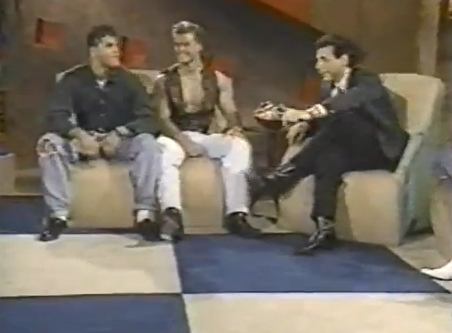
Male contestants from Studs.  Note the guy on the right with his vest of awesomeness.  He's French, although that's no excuse.  Plus ... are they pegging their jeans?

Male contestants from Studs. Note the guy on the right with his vest of awesomeness. He’s French, although that’s no excuse. Plus … are they pegging their jeans?

Anyway, so Mark would do the introductions–what do you ladies like in a man–while the audience (who was obviously imported from a taping of Married … With Children) would hoot and holler.  He’d bring the other contestants out and do the same, which is pretty standard for this type of show.  Then, the show would get into what it was known for, which was the multiple choice quiz.  The guys would hear statements about what happened on the date and if they figured out what girl said what, the guy would win a stuffed heart.  The guy who got the most hearts would win.  Pretty standard, right? Well, that is, until they actually got to the questions.

You see, since this was a show with “Fox Attitude,” Studs didn’t simply ask the guys and girls where they went to dinner, but they insinuated that every single one of them engaged in several acts of carnal knowledge that are illegal in most Bible belt states.  Mark always started with questions about first impressions (mostly appearance based) and we’d get stuff like “He looked like a puffed-up Ken doll” or “All  he had to do was say my name and I melted” (yunno, because the guy had an accent), but eventually we got to the actual date and instead of being all censor-friendly, the statements were full of innuendo or flat out “sexy.”

“He showed me what it means to be a woman.”

WOOOOOOOO!

“It was all I could do to keep from screaming out loud.”

WOOOOOOOOOOOOOOOO!

An example of the infamous multiple choice section of an episode of Studs.  Your tongue takes over and then you party all night long, right?

An example of the infamous multiple choice section of an episode of Studs. Your tongue takes over and then you party all night long, right?

“My mouth opened wide and my tongue took over.”

WOOOOOOOOOOOOOOOOOOOOOOOOOOOOOOOOOO!

Now, I don’t think that I would have found any of this talk sexy or remotely risque when I was in my twenties.  But when I was watching this on a weekday afternoon as a fourteen-year-old?  Oh hell yes.  My friends and I used to wonder how many of the contestants actually did it, and thought that the show was completely awesome because everything was a sex reference.

Studs lasted two years, but I don’t even know if I watched it beyond six months or a year before I got bored with it, although that was long enough to get the brilliant “Amish Studs” parody courtesy of The Ben Stiller Show.  But I don’t think it was ever meant to be more than a novelty anyway, and the same can be said for Singled Out, Blind Date, and whatever shows have come out in the last couple of decades.  They last long enough to cure boredom but eventually, like most of television, is quickly forgotten.

You can watch an episode, courtesy of YouTube, below: