Author: Tom Panarese

Coke is It!

One of my favorite aspects of Mad Men is the constant looks into the ad pitch meetings.  Maybe it’s because I used to work in sales support and marketing, but whenever Don or one of the other guys at the company is trying to get new business, I find it fascinating how they not only come up with their ideas but how they present it to the prospective clients.  Sometimes, it’s brilliant, and sometimes they crash and burn, like in this clip that shows the company pitching Pepsi on their new diet cola, Patio:

I think my favorite part of this clip is Roger Sterling summing up why the commercial doesn’t work:  “It’s not Ann-Margret.”

But I love soda commercials.  I don’t think I’ve seen that many from the era of Mad Men–the earliest ones I can remember is probably the “I’d like to buy the world a Coke” one from 1971 followed by David Naughton’s “I’m a Pepper!” ads and the Mean Joe Green one from 1978 or so–but I do remember that next to commercials for the phone company, McDonald’s, and Juicy Fruit, nothing in the non-toy category defined my childhood more than soft drink commercials.

And for good reason: they were everywhere in the 1980s, to the point where the last line of the last verse of “We Didn’t Start the Fire” is “Rock and roller cola wars, I can’t take it anymore!”  And by 1989, yeah, you’re right, Billy.  Because over the course of the decade, Coke and Pepsi seemed to be doing whatever they could to up the ante, especially when it became apparent that Pepsi was gaining in market share right around 1985 and Coke decided that its old formula wasn’t enough and launched the debacle known as New Coke.  Plus, you really couldn’t outdo Pepsi’s commercials in the 1980s.  I mean, they almost killed the King of Pop.  That set the bar impossibly high.

But as much as I have fond memories of watching the “Michael Jackson’s hair catches on fire” commercial on my old taped-off-TV copy of The Wizard of Oz from 1983, I have to say that one of my favorite 1980s soft drink commercials has to be this Coke ad from 1982:

Now you can picture this pitch meeting, can’t you?  “So, has anyone seen Fame?” (more…)

Sometimes, you learn that you have to settle for less.

The Autobot known as Huffer, who would play a more significant role in my childhood than it should have.

I am sure that in the annals of our toy collecting histories, there are toys that we remember so vividly and consider so important that the day we received them ranks as high as the senior prom, first kisses, and getting married. Okay, maybe that’s a bit of an exaggeration, but ask any child of the Eighties about Castle Greyskull, the AT-AT, or Optimus Prime and you’ll probably get an enthusiastic response followed by a wave of nostalgia appropriate to key toys to the era.

You probably won’t get the same if you mention Huffer.

If you’re unsure of who or what “Huffer” is, he was one of the Transformers “mini-bots,” a line of small, affordable Transformers that came out with the first wave of the toys in 1984. As most Transformers were sold in boxes, mini-bots were placed on cards and hung in aisles as if they were regular action figures, and although I don’t know their exact retail price, they probably cost as much. The most famous of the mini-bots was Bumblebee, who in his first incarnation was a yellow VW Bug (in the current iteration, he is a Camaro), but in that first wave, you had characters like Cliffjumper, the red car voiced by Casey Kasem on the cartoon series, and Huffer, an orange semi who was an Autobot that had very few appearances in the cartoon and seemed to be around when Optimus Prime needed someone to take his trailer. The times when he did have a speaking role or a spotlight, he was kind of gruff and obviously homesick for Cybertron. So for the most part, he was a supporting or background character.

Huffer as featured on the Transformers cartoon series.

But he was a supporting character who seemed to be everywhere. Huffer was the Transformers equivalent of Prune Face or Squid Head, a figure that seemd to come out for the toy line as a way to just suck more money out of our parents’ wallets but had little or nothing to contribute to the overall storyline. Plus, everyone seemed to have him because he was an “introduction level” transformer. Mini-bots were easy to transform (and probably easy to make) and were very cheap; therefore, they were ubiquitous in both toy stores and Christmas stockings. Optimus Prime, Megatron, Jetfire (Skyfire?), or Shockwave would set your parents back a decent amount of money and might require that they fight their way through a horde of shoppers in the early hours of Black Friday, but your lazy aunt could pick up Huffer on Christmas Eve and have money left over to buy Squid Head.

Most importantly, though, or at least to me, is a symbol. He’s the toy you got because you couldn’t get anything else. There were others like this in the line–Thundercracker was a blue version of Starscream, but still a pretty cool toy–but Huffer was relatively useless. Going to a toy store and walking out with Huffer meant that you were either a completist or it was a consolation prize. In my case, it was the latter.

In 1984, He-Man and the Masters of the Universe was still pretty popular, especially because the cartoon was still on the air and Mattel had started releasing action figure versions of some of the characters on the show. One particular character that got his own action figure was He-Man’s alter ego, Prince Adam of Eternia. Now, looking at that figure now, it’s kind of ridiculous that you’d want it–he was basically He-Man with purple pants, a white shirt, and a maroon jacket. I mean, it wasn’t even a good alter ego figure like the Super Powers Clark Kent figure. Still, I watched He-Man every day (and my sister would watch She-Ra) and there was a point in every episode where Prince Adam would hold aloft his sword and say “By the power of Greyskull … I HAVE THE POWER!” and transform into He-Man, then transform his tiger named Cringer into Battle Cat. Playing with my He-Man figures, I wanted to be able to “play” that transformation. Transforming Cringer into Battle Cat wasn’t hard–Battle Cat’s armor came off–but I had no way of transforming anyone into He-Man.

Prince Adam, the alter ego of He-Man. A toy that I broke down and cried over, something which defies rational explanation now that I think of it.

Until, that is, I first spotted Prince Adam in the toy aisle of TSS. It was in the middle of the fall and I had no idea that Prince Adam had been made into a figure and despite the purple pants and maroon jacket, I wanted him right away. I wanted to be able to take him, have him hold his sort aloft, say “By the power of Greyskull … I HAVE THE POWER!” and become He-Man (either original recipie or battle-damaged … I had both). I ran and got my mom, dragged her over to the aisle, and enthusiastically declared that I wanted the action figure and that I’d been a good kid and wanted it right then and there. Her response was something along the lines of, “Not right now but if you’re good, dad will take you back tonight.”

This seemed like a good enough response to me and we left TSS. My dad got home later that night and took me up to TSS because apparently I had “earned” my Prince Adam action figure. Remembering what aisle in the toy section it was found, once we entered the doors, I ignored the smell of fresh soft pretzels (which I lived for back in the day and to an extent still do) and made a bee line for the toys.

But it wasn’t here.

I began to cry, and my father probably got the same “Are you kidding me with this?” look that I get on my face when my son cries over insignificant things–only my son is five and I was seven at this time so you think I would have gotten over it by then–and he did what so many dads have done in that situation over the years, which is said, “Well, you can get something else.” Since TSS was not Toys R Us and what was there wasn’t much, so I grabbed which was the most readily available toy at the moment, and that was Huffer.

We went home, and while I did eventually get Prince Adam that Christmas, I never forgot that I missed out on my chance to get something because my mom had said, “Oh, we’ll come back later,” which is one of the most rookie fo mistakes you can make when shopping for toys, a mistake I’m sure I’ve made a few times these past few years (although my son doesn’t realize that). And every time I looked at Huffer, I thought of that moment and the disappointment I felt and how I made solemn vow to never let that happen again.

Okay, it wasn’t that dramatic, but the seven year old me hated that toy for that reason and nearly 30 years later I still kind of do.

Introducing … Pop Culture Affidavit: THE PODCAST!!!

It’s the very first episode of the Pop Culture Affidavit podcast!  Each month, I’m going to be offering a “deluxe-sized” version of my blog posts … mainly stuff that I have really wanted to talk about but that I consider “special” enough to warrant about an hour’s worth of time in an audio format.

This first episode is all about the summer of 2012, including movies, comics, and my trip to the Baltimore Comic-Con.

You can listen here:

iTunes:  Pop Culture Affidavit

Direct Download 

Pop Culture Affidavit podcast page

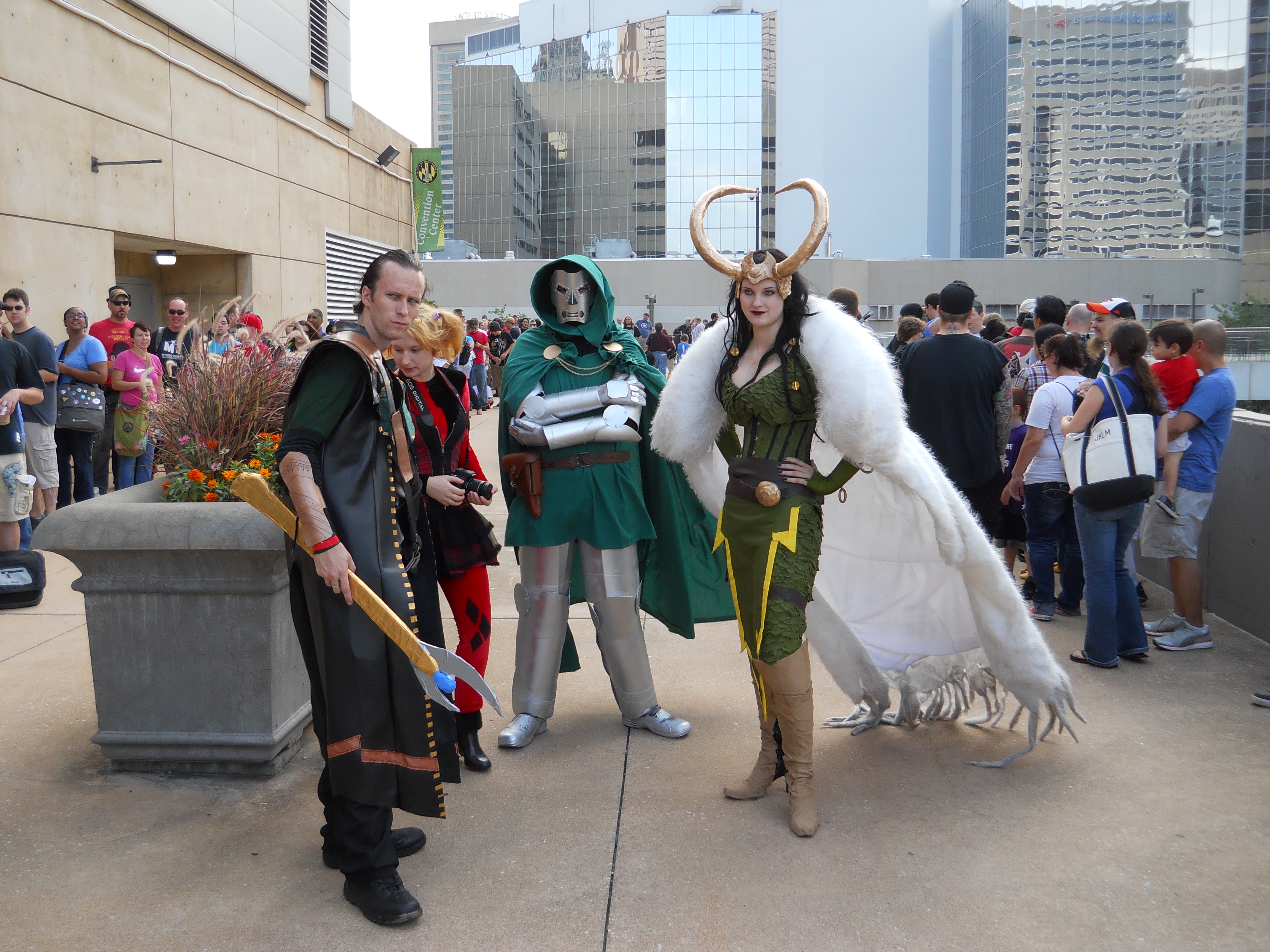
Below are the pictures I took at Baltimore Comic-Con, including people I saw as well as comics and TPBs I had signed.

The line to get into the Baltimore Comic-Con. It moved quickly, which was a pleasant surprise.

“Doom says that this line is too long! Doom shall not wait in line with Loki! Doom shall cut the line!”


I do love anyone with the thought of attending a con as Darkseid.


The new Captain Marvel. A GREAT costume.

(more…)

Get Down Tonight

All of the pictures from the night in questions aren’t ones that my friends and I want floating around the web, so here’s a picture of the Humanities building.

I was cleaning a couple of weeks ago, doing the semi-annual “purge” of random useless stuff from the house, and among the old clothes and toys that were going to Goodwill was a pair of commemorative glasses from my college freshman-sophomore semi-formal more than 15 years ago.  I’d like to say that I had held onto the glasses because I wanted to cherish the memories of that time in my life, but to be honest, I’m one of those people who is too lazy to buy new glassware so I simply hadn’t gotten rid of it earlier.

That’s not to say that retiring the glasses didn’t make me think of the night in question.  Unfortunately, my adoring fans (both of them) will be disappointed to find out that the freshman sophomore semi, held April 26, 1997 with the theme of “Get Down Tonight” was not epic, grand, illicit, or even out of the ordinary, but instead was just like any other Saturday night in college.

Okay, I was wearing a jacket and tie.

It seems weird that a college SGA would throw dances, or at least that when they threw the dances, people actually would attend.  College students are supposed to spend Saturday nights getting hammered on Natty Ice and throwing up into a trash receptacle outside of the library (which, of course, marks the only time in college they actually go to the library), not getting all dolled up and posing for pictures like it’s a high school homecoming dance, although everyone looks ten times worse than they did at homecoming due to college beer bloat and the fact that a dorm room doesn’t make for a very good area to primp.

On some level, attending a dance at my college kind of made sense because you really had nothing better to do, especially if you were one of those students who could not get into the bars and wanted some excuse to drink other than it was a weekend night.  They were held in Reitz Arena, which is the same gym where the D-I Greyhounds played basketball … and I use the word gym because it really is a glorified gym.  Sometimes the dances were held in the student center, but no matter where they were held, they always felt kind of like a high school dance, not something you’d expect in college. Oh sure, I went to a few sorority functions when I wa sdating my wife, but I can’t remember if she had a school-wide freshman-sophomore semi held in her university’s gym.  Considering that The University of Virginia has about four times the population of Loyola College in Maryland, I’m probably right about that.

The music didn’t help, either.  Our theme, “Get Down Tonight” came about probably because the late 1990s had a fair amount of nostalgia for both the late 1970s and 1980s going for it.  Disco kind of made a comeback at that point, especially (and strangely) groups like K.C. and the Sunshine Band, whose three or four hits had become staples at weddings by then.  They also weren’t hard songs to track down because they were featured heavily on the ever-popular ESPN Jock Jams albums that were released from 1995-1997, which my friends and I were all convinced were the only CDs the deejay that the SGA hired actually owned.  I mean, how do you explain that the dance remix of “What’s Up?” by 4 Non Blondes was popular in 1996, 1997, 1998, and 1999?

Maybe he was counting on the fact that we were too blitzed to pay attention to the music.  If you were going to a school dance, you showed up already drunk because you spent the afternoon pre-gaming in your dorm room (one night had my five of us–my roommates and I plus my girlfriend—drink an entire keg during said pregaming) and maybe danced with your friends for the better part of an hour before, much like a high school dance, things got boring, drama happened, ro someone required some hair holding.  I don’t think that anyone could really say that they were monumental romantic benchmarks.

Well, I should be more specific because for all I know someone first kissed his future wife at the freshman-sophomore semi.  So let’s just say that these dances were never really monumental for me.  I can’t decide if that’s because I put too much pressure on myself to have an amazing memorable time, or if I’m a complete romantic putz.  Or both.  Probably both.

But for what it’s worth, I went, danced, got my glass at the end of the night and went on with my life, developing a roll of film that probably won’t see the light of day and shrugging my shoulders at the thought of remembering and cherishing the night for the rest of my life.  Unless I’m supposed cherish it and I’m doing it wrong, because in all honesty, I had to stretch to think about what exactly went on that night.  I’m pretty sure there was drinking, sex, and definitely fighting among boyfriends and girlfriends, but ultimately it was fuzzy and fleeting, lost among the randomness of a time in my life that never made much sense and probably wasn’t supposed to anyway.

America’s Pastime

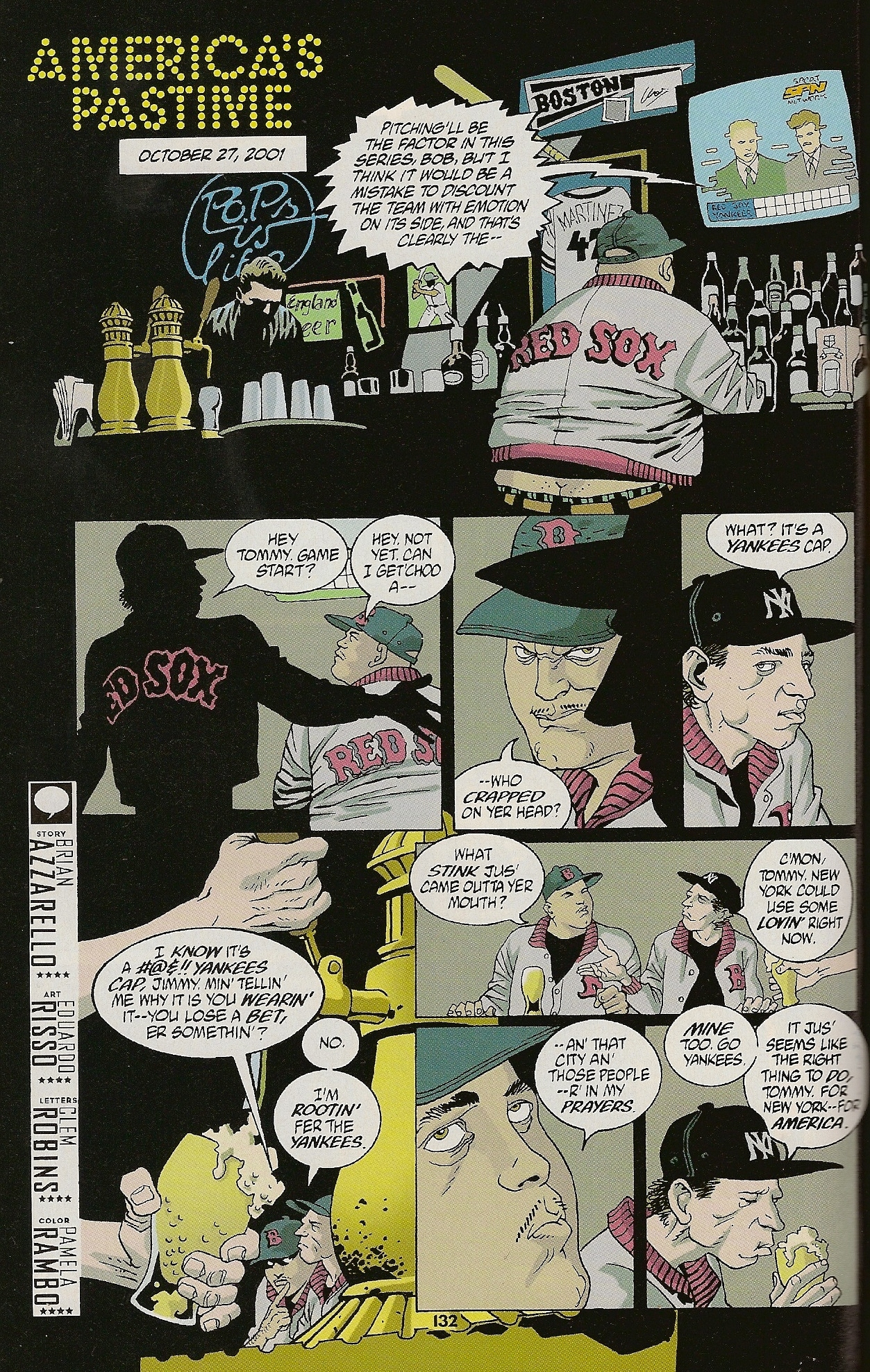
Page 1 of “America’s Pastime” from the 9-11: Volume 2 collection.

We open on a bar on the night of October 27, 2001.  A Red Sox bar, specifically, based on the Boston pennant on the wall above what I believe is a framed Pedro Martinez jersey (although the jersey is #47 and Martinez wore #45, but anyway …), and the big guy in a Red Sox jacket nursing a beer and watching Game 1 of the World Series.  A moment later, his friend walks in and the big guy, Tommy, notices that his friend, Jimmy, is wearing a Yankees hat (more specifically, he asks, “Who crapped on yer head?”).  Jimmy explains that after all New York has been through, it seemed that rooting for the Yankees was the right thing to do, for both New York and for America.  Tommy reminds him that they’re from Boston and that despite what happened, they do not, under any circumstances, root for the Yankees.  He runs down the list of what their team from Boston–“The Birthplace of America” as he calls it–have been through: Buckner, Mo Vaughn leaving, Clemens pitching for New York, Yankees’ fans cockiness, Derek Jeter, and tells Jimmy, “What happened on 9/11–you can’t let if affect you that way, Jimmy, ’cause that’s what they want.  I’m tellin’ you–if you root for the #@$!! Yankees … the terrorists win.”

Jimmy thinks for a moment, puts his hat down on the bar and says “Go D-Backs.”

That’s the gist of a two-page story entitled “America’s Pastime” written by Brian Azarello and drawn by Eduardo Risso that was published in 9-11 Volume 2, a DC Comics-released collection of short pieces that were done as a reflection on the events of September 11, 2001.  Along with the first volume, which was produced and published by several “indie” comics companies, the profits of the sales of this book went to the 9/11 victims funds, and featured many pieces that were done by both minor and major comics creators and for the most part used ordinary heroes in their stories (although there were a few super-hero-related stories in the DC one).

I briefly mentioned this particular piece last year when I wrote about “This Too Shall Pass,” the Marv Wolfman-penned story that starred Raven of the New Titans, and did say that it is one of my favorite pieces in the book because Azzarello’s script gives us a little bit of levity in a volume that can often get heavy-handed.  But looking at it a little more closely this year as I reread this and other pieces, I wanted to write about it because it made me think of one of the very first posts on my very first blog (which was called “Inane Crap”).  Dated October 24, 2001, it was called “I Guess I Hate New York” and is more or less a rant that is similar to the one in Azzarello and Risso’s story, as I expressed my frustration with the idea that suddenly the Yankees were America’s team and that rooting for them to win the World Series was somehow the “right” thing to do: (more…)

Food for Thought

Final still from “Food for Thought” courtesy of Degrassi.ca

My relationship with Degrassi seems to have been more complicated than I originally through.  I mean, it was a television show, it was on when I was home from school, and I watched it.  But it’s not like it was Saved By the Bell, which everyone watched (mainly because it was on.  It always seemed to me that SBTB being on television when you were home from school was like a USA Today being placed at your hotel room doorstep–there was nothing else to do, really.)  In fact, aside from one fleeting moment where I felt cool at the bus stop because the cool older kids had watched it, with the possible exception of my sister, I was the only person I knew who watched Degrassi.

To that extent, I developed sort of a complex.  When other people walked int he room during my Degrassi time, I felt as if I had been caught doing something, even though all I was doing was watching Canadian teen melodrama.  Okay, Degrassi Junior High wasn’t always that melodramatic, but this episode, “Food For Thought,” which tackles the issue of eating disorders, lays it on pretty thick.  In fact, it does that right away, as we open with  Kathleen (one of the more uptight and bitchy Degrassi girls) sitting at the dinner table while her workaholic father and alcoholic mother argue back and forth.  She excuses herself without eating, then goes to the bathroom, looks in the mirror and says, “You’re! So! Fat!”

Did I say that they’re laying it on thick?  I meant that they’re spackling it on. (more…)

Night Moves (My Life as a Teen Titan, Part Thirty)

BATMAN_A_LONELY_PLACE_OF_DYINGIf the New Titans was, after issue #100, anywhere near the quality that Marv Wolfman, Tom Grummett, and Al Vey had been delivering when I started picking up the title with issue #71, I probably would have been felt that New Titans #113 was a monumental comic book.  But Bill Jaaska was still on the artwork and the series had been limping along for the better part of a year, so I probably skimmed through the issue upon buying it and then set it aside so that I could dive into the latest chapter of KnightsEnd, Mark Waid’s run on Flash, or anything that was going to clue me into what Zero Hour was going to be about (especially since my beloved Team Titans were apparently agents of Monarch).  As a result, it never registered with me that New Titans
#113 and #114 was the last time for a long time where Marv Wolfman would write Dick Grayson (he’d return to the character for guest spots on various Titans-related titles and have a run on Nightwing after Infinite Crisis, but after these two issues, Master Grayson was put in the capable hands of Chuck Dixon).

When you consider that Dick Grayson and Tim Drake were basically the reason that I started collecting comics for real in 1990, that’s actually kind of sad.

I bought comics for about a year–most of 1987, in fact–and since most of those comics were toy-based (G.I. Joe/Transformers), the wane in my reading and collecting coincided with the wane in my interest in toys.  By the fall of 1987, my interests turned to more hardcore action/sci-fi movies like Aliens and Predator and my friends and I were tuning into the WWF twice a week when we weren’t playing Nintendo or playing baseball.  With the exception of a random trip or two to the comic store, I didn’t really pick anything up until the summer of 1990 when friends of mine had started reading Batman comics on the regular.  So after thumbing through a few issues, I picked up Detective Comics #617, the “middle chapter” of a three-part “Return of the Joker” story (that is a surreal story that isn’t vital to the other parts, which were in Batman #450 and #451 and is more or less a side dish).

But what made me stay was the next issue, Detective Comics #618.  In that issue, Tim Drake’s parents are kidnapped and he starts what would be the penultimate story arc toward his finally putting on a new Robin costume in Batman #457.  Concurrently, in New Titans #71, the Titans are kidnapped and Dick Grayson is among those looking for him and … well, if you’ve read the past 29 blog posts in this series, you know what I mean.

It took about four years (almost to the month–the Titans Hunt started the same month Batman #456 was published) for the team to finally be completely dismantled and the one character who was instrumental in getting and keeping the team together through his leadership to finally walk away for good.  Now, if I’m being completely accurate here, Nightwing hadn’t really been leadning the team since issue #100 because of what had happened at his “wedding” to Kory.  But during the year’s worth of Titans issues (and a few issues of Flash and some Bat-related books as well), there was always the underlying sense that when this was all over and Kory was saved and Raven was defeated, then Nightwing would return to leading the classic Titans lineup.  Yes, they would have changed slightly–Cyborg’s new body and Donna Troy’s job as a Darkstar being great examples of this–but the classic New Teen Titans would be back.

This was not to be.  New Titans #113 happens more or less simultaneously with the previous couple of issues, but instead of the satellite where the Titans are kissing Kory back to “normal,” Dick is in the jungles of South America on some sort of voyage of self-discovery where he canoes down rivers and hangs out with native tribes that have the kind of half-nude women you’d see in old issues of National Geographic.  It’s the kind of plot device that has you sort of shaking your head and going “really, Marv?” but also makes total sense.  After all, Dick is the “son” of a very wealthy person and needs to do something to cast that aside instead of trying to prove that he is/isn’t/is better than/is over his relationship with his “father,” which is what he’s been doing since he put on the Nightwing costume … at least in the post-Crisis.

And I guess we should talk about that, right?

The storyline that is arguably the most famous in New Teen Titans history is 1984’s “The Judas Contract.”  It’s a four-part story that is the culmination of not one but two years’ worth of comics that began with the introduction of the character Terra in New Teen Titans #26.  Actually, let me walk that back slightly–it’s technically the culmination of something that had been going on since the end of New Teen Titans #2 in 1980.  In that issue, Grant Wilson gets superhuman abilities from the H.I.V.E., who stole them from Deathstroke, and then takes on the name of The Ravager and a mission to kill the Teen Titans.  However, his powers overload his physiology and he winds up dying, leaving Deathstroke to take on that contract.

Slade Wilson appears one more time after that, in issue #10, where he tries to nuke the Titans and kills Changeling (who is brought back to life on Paradise Island in the following issues) and more or less lays low until issue #34, where Terra, having become a newly inducted member of the team, is key to his defeat.  We then learn that said defeat was a setup to get the Titans to trust her some more–after all, she’s working with Deathstroke to uncover their secrets.  The result is “The Judas Contract,” where Deathstroke and Terra play their endgame, capturing all of the Titans and giving them to the H.I.V.E.
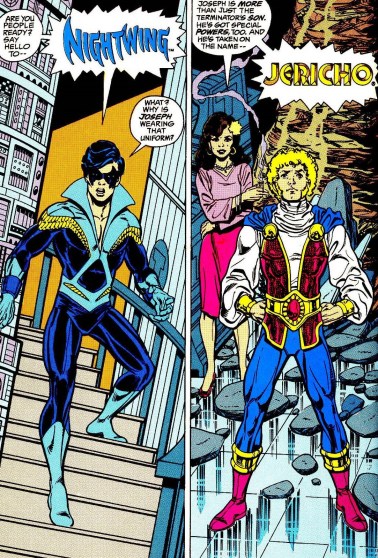
Itsnightwing

Dick Grayson makes his official debut as Nightwing in Tales of the Teen Titans #44.

“The Judas Contract” is amazing for its being a four-part finale where the payoff for years of buildup was satisfying (although full disclosure–I didn’t read these issues as they come out, so I’m only speaking from my experience of doing several read-throughs) but also because it was a game-changer for DC.  In Tales of the Teen Titans #44 (the title switched names in order to make way for the direct market-only “Baxter series” that would hit the shelves about a month after “The Judas Contract” finished), Dick Grayson puts on a new costume and says, “Are you people ready?  Say hello to NIGHTWING!”  At the same time, over in Batman, a kid named Jason Todd was putting on the Robin costume for the first time.


When you think about it, this was huge.  Dick Grayson had been Robin since his debut in Detective Comics #38 in 1940 and up until the late 1960s, he had been Batman’s trusty sidekick, a “Boy Wonder” in every sense of the word.  When the Dark Knight was reinvented for the Silver and Bronze Ages, Mr. Grayson was aged and sent off to college–no longer a boy, he was the teen wonder and would be so through much of the 1970s.

When DC Comics Presents #26 and The New Teen Titans #1 rolled around in 1980, not only was Dick Grayson a teen wonder, he was showing signs of having outgrown his pixie boots and short pants.  He dropped out of college and had moved back into Wayne Manor and that had begun to cause tension between him and Batman.  This tension grew throughout the New Teen Titans series, especially in late 1983 when Jason Todd was introduced to the Batman titles and was being groomed to be the second Robin.  When the Titans teamed up with Batman and the Outsiders in New Teen Titans #37 and Batman and the Outsiders #5, the tension was so high that the Dynamic Duo openly argued with one another.  Two issues later, Dick announced that he was giving up being Robin and after a two-part Brother Blood story and Deathstroke failing to capture him in part two of “The Judas Contract,” Dick became Nightwing and teamed up with Slade’s other son, Joseph, aka Jericho, to stop Deathstroke, Terra, and The H.I.V.E.

titans-outsiders

The poster version of the covers to The New Teen Titans #37 and Batman and the Outsiders #5, which was done by George Perez and Jim Aparo, two of the all-time DC greats.

Which they do.  Jericho jumps into Deathstroke’s body and frees the Titans from whatever the H.I.V.E. was holding them in (it’s one of those Rube Goldberg devices that drains powers and kills heroes that villains were into back in the Bronze Age) and a huge melee breaks out between the Titans, the H.I.V.E., Deathstroke, and Terra, with Terra finally snapping and trying to kill everyone but doing herself in.  It’s a tragic ending and a pyhrric victory that only gets more painful in Tales of the Teen Titans #55 when Changeling drags Slade Wilson out of court to get him into a confrontation so he can murder him but then has a cup of coffee and a nice long talk.  No, that’s really what happens and it’s actually a well-scripted issue because it gives those two characters depth in a way that few writers ever could (on a side note, Peter David will outdo Wolfman in the early 1990s with X-Factor #87, a stand-alone “therapy” issue that is still one of the all-time greats).

From here, Nighwing goes on to lead the Titans and while his relationship with Kory has some bumps, he gets closure with Batman and really is his own man.   Until the Crisis and then Max Alan Collins come along.

If there’s one Titan whose entire story was monumentally screwed up by the events of Crisis on Infinite Earths, it’s Donna Troy.  Second to her is Dick Grayson.  If you look at any of the other founding members of the team–Raven, Starfire, Cyborg, Kid Flash, Changeling–the Crisis comes and goes and they’re more or less fine.  However, Donna’s history gets messy as a result (and I covered that in past entries in this series) and so does Dick’s because of the way the Batman books changed Jason Todd.

The pre-Crisis Jason Todd was more or less a Dick Grayson clone.  Yes, there were differences is his story and Dick’s, but the kid was a circus kid whose parents were killed and who eventually became Robin.  It fit what DC was going for at the time, which was to get the image of a classic Dynamic Duo back into the forefront.  After the Crisis, Max Alan Collins took over the writing on Batman while Mike W. Barr did a woefully underrated run on Detective Comics (a run that–and I realize it’s sacreligious to say this–feels more Batman than Frank Miller’s Batman).  While Jason appeared alongside Bruce in ‘Tec, Collins spent a few issues reinventing and retconning the character, which also completely redid the relationship between Bruce and Dick.   Batman #408 is titled, “Did Robin Die Tonight?” and in that story, Dick (as Robin in his only post-Crisis Robin appearance at this point) is shot by The Joker.  Batman, saying that Dick made a stupid mistake and let himself get shot, fires his partner.  An issue later, he catches Jason Todd trying to steal the tires off of the Batmobile.  Missing his partner and thinking that this kid has serious spunk, Batman takes him under his wing as a new Robin.

This version of Jason Todd was met with derision from a number of fans, especially after Batman #423, when he kinda sorta kills a drug dealer by not helping him when he falls off an apartment balcony.  This Jason was a smart ass, a punk, and not the type of kid you thought deserved to be Robin, no matter how much Batman thought he needed saving one way or the other.  So the fans voted to kill him in the infamous “A Death in the Family” storyline, something that would reverberate and have consequences all the way up until and through the day I picked up that copy of Detective Comics #618.

Which is to say, it was all prologue, and all things I hunted down either in trade or in back issues so that I could read what I felt was the “full story of Nightwing.”  And if you want, you can create your own “Marv Wolfman’s Nightwing” (with some other writers thrown in at times) by reading the following books (and a quick note here–I limited this to stuff published between 1940 and 1994-95, so some storylines that came later, such as Chuck Dixon’s Robin Year One, Batgirl Year One, and Nightwing Year One are not here, although they do add some great stuff to the Nightwing mythos) …

Detective Comics #38: Not 100% necessary because in the post-Crisis DCU, Wolfman will tell this story in Batman: Year 3, but this is the introduction and origin of Robin and even if you’re reading the character in a modern context, I think it’s important to go back and look at where he started. Furthermore, I think it’s important to see how dark his origin was–the death of his parents and subsequent tracking down of his parents’ killers are gritty and real to the point where they hold up better than any other version of this that I’ve seen.

The Brave and the Bold #54, Teen Titans (1964 series) #14, Batman #312, Teen Titans (1964 series) #53:  While I’m sure there are other essential stories from the original “Teen Titans” run as well as Robin stuff in the Silver and Bronze Ages, these four comics are a quick look at the evolution of Dick Grayson from “Boy” to “Teen Wonder.”  B&TB #54 is the very first Teen Titans adventure (although it happens sans Wonder Girl) and if you can pick out any crucial Teen Titans issue regarding Robin, it’s issue #14 with its famous Nick Cardy “Quit, Robin, Quit!” cover.  Self-doubt would become a running theme for Dick and we even see some of it in Batman #312, where he leaves Wayne Manor for Hudson University (and Bruce subsequently moves out of the Manor and into the Wayne Foundation building, which is where he would be for much of the 1970s).  Teen Titans #53 is the last issue of that series and serves as a retcon of the original meeting of the team as well as a reference point for where Wolfman will pick things up a few months later.  If you want to dive deeper into this, I’d also recommend picking up the Steve Engelhart-written/Marshall Rogers-pencilled issues of Detective Comics that were collected into the “Strange Apparitions” trade paperback a number of years ago.

DC Comics Presents #26, New Teen Titans (1980 series) #1, 2, 10:  While #10 has little to do with the Batman and Robin angst going on, it helps to read it so that you can see a solid Deathstroke appearance before you get into the meat of the goings on with “The Judas Contract” and you can understand why there’s such animosity between Slade and Gar Logan.  The DCCP issue is the first appearance of this new team and issues #1 and 2 do show some of the tension that’s been building up between Bruce and Dick–when Dick heads out to meet Donna at the beginning of issue #1, he thinks about how Bruce has been upset with him as of late because he dropped out of college.  Issue #2, which is Deathstroke’s first appearance, plants the seeds for what we’ll see later.

New Teen Titans (1980 series) #26-27; Justice League Quarterly #17; New Teen Titans (1980 series) #28-34, Annual 2; :  The Titans return home from an epic adventure on Tamaran, Dick and Kory begin their relationship, and we are introduced to Terra.  The last few issues of this run reveal that Terra has been working with Deathstroke and also introduce Adrian Chase as The Vigilante.  It’s this case that has Robin begin to seriously rethink his role as Batman’s partner, and while he does not go down the route of killing perps like The Vigilante does, he sees that perhaps he needs to be more hard-edged.  Terra, it should be noted, does not immediately go on the attack.  It will take another year for her and Deathstroke to make their move.  The Justice League Quarterly issue is not vital–it just happens to have a follow-up to the “Runaways” storyline from #26-27 that I have always absolutely loved.

New Teen Titans (1980 series) #37; Batman and the Outsiders #5; New Teen Titans (1980 series) 38; Batman #408; New Teen Titans (1980 series) #39; Batman #409, 410, 411; Tales of the Teen Titans #40-44, Annual 3, 53-55; Annual 3:  “The Judas Contract” and its aftermath, with the origin of the post-Crisis Jason Todd weaved in.  It’s not the smoothest thing, but if you read the Titans-Outsiders team-up followed by “Who is Donna Troy?” and then “Did Robin Die Tonight?” you can head into the “Robin Quits” issue of New Teen Titans (with the iconic “Dick and Wally Walk Away” cover) before reading the introduction of the new Jason as going on parallel to the events of the Brother Blood storyline and “The Judas Contract.”  Again, the three issues of Tales of the Teen Titans that come out after the annual are not Nightwing stories but they give Changeling and Deathstroke closure (to the point where with the exception of a cameo or two, Slade doesn’t appear in a Titans book until 1988/1989).
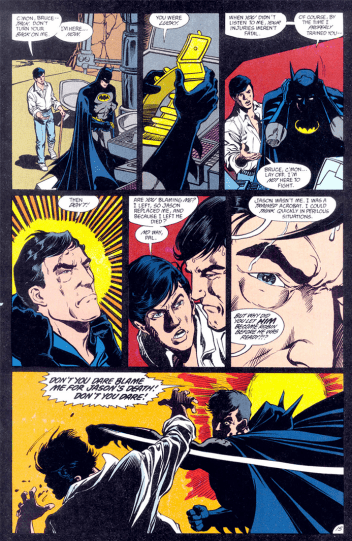
BatmanNightwing

New Teen Titans (1984 series) #19, 20, 21; Teen Titans Spotlight #14; Batman #416:  The three issues of the baxter series are more vital to the long-running Tamaran and Brother Blood storylines (and I mean loooooong ruuuunnnning) than anything, but there’s more of Wolfman giving Dick serious doubts.  Teen Titans Spotlight #14 is a great Batman/Nightwing team-up and goes well with the first post-Crisis meeting between Dick and Jason in Batman #416, which is still one of my favorite Jim Starlin Batman issues.

Batman #426-429; New Titans #52, 55:  The Batman issues are “A Death in the Family,” where The Joker kills Jason Todd.  The Titans issues are part of the “Who is Wonder Girl?” storyline and you need to read just a few panels of #52 (Danny Chase searches for Jason Todd on the CBI databases and can’t find him, leading him to think he’s dead) and a few pages of #55 (Danny smart-mouths his reaction to Jason’s death, Dick goes off on him and then heads to the Batcave to confront Bruce. After Bruce decks him, Dick realizes that Danny is a pain in the … I mean, too young for this … and fires him from the Titans).

Secret Origins Annual #3; Batman #436-439; New Titans #57-59:  The Secret Origins annual tells the history of the Teen Titans all the way up until this point through the perspective of Dick Grayson being haunted in his nightmares by an old enemy.  The main thing to read here is Batman: Year 3, which is in those four Batman issues.  Marv Wolfman and Pat Broderick deliver a post-Crisis version of Dick Grayson’s origin as well as have him work out some of his present-day issues with Bruce.  It’s actually unique to the “Year” storylines as it doesn’t happen entirely in flashback the way Year One and Year Two do.  The Titans issues are a side dish–a few pages in each update us on the team’s concern for their leader as well as help set up the next storyline.
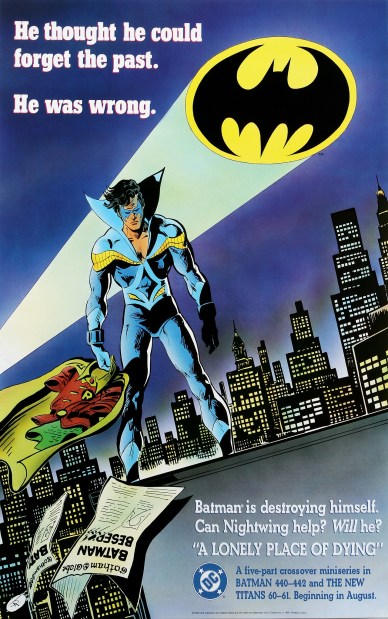
Lonely Place of Dying Ad

A DC house ad for “A Lonely Place of Dying.”  Art by Jim Aparo.

Batman #440-442, New Titans #60, 61, 65:  “A Lonely Place of Dying.”  Batman is starting to run amok.  Two-Face has grand plans.  And Tim Drake tracks down Dick Grayson, revealing that he knows who he is and he knows that Batman not only needs help, he needs Robin.  It is a sequel to “A Death in the Family” that has Tim putting on the Robin costume for the first time, at least momentarily, and starts him on his road to being the next Boy Wonder, which wouldn’t officially happen for another 15 issues.  The story in New Titans #65 is one where Tim visits Dick in New York and learns some things about what it means to be Batman’s partner as well as a detective.  It serves as an outstanding epilogue to “A Lonely Place of Dying” and makes me appreciate the time that Wolfman, Alan Grant, and Denny O’Neil would put into developing Tim Drake’s character before he actually became Robin.

A couple of notes here:  “Year 3” was wiped out of continuity post-Zero Hour when Robin’s origin was retold in Robin Annual #4 and then later on in Robin: Year One.  However, “A Lonely Place of Dying” stayed in continuity for years afterward, even being packaged in a new “A Death in the Family” trade.  It’s also at this point where you can follow Tim Drake’s road to becoming Robin in Detective Comics #618-621, Batman #455-457, and the first three Robin miniseries before he gets his own book.  Nightwing’s story continues in New Titans #71, which was the first post in this blog series.  After reaching New Titans #113, you would read #114 and then head to Robin #0 followed by the “Prodigal” storyline, which is about Dick temporarily serving as Batman.  At the end of that story, he heads off into his own miniseries and eventually into the Chuck Dixon-penned title of the late 1990s.

But I won’t be going too far into those.  Instead, I’ll be sticking with the Titans themselves and talking about their disillusion and reformation.

Next Up:  The Titans fall apart while Zero Hour rages on.


The taste that’s gonna move you!

I’ve never been a regular gum chewer.  Oh sure, I have a pack of peppermint gum sitting next to me while I’m typing this but that’s because I had serious onion breath the other day and went out and bought said pack so I could talk to people in a professional capacity without killing them.  But really, I’m not a regular gum chewer.  It might have something to do with the fact that from the third grade on and off until my sophomore year of high school, I had braces; however, I like to think that it’s because I am ultimately disappointed that I never had the experiences that gum companies promised me in the 1980s.

Commercials for gum these days seem to hype the product’s taste, making it seem that chewing a piece of 5 gum will make your entire body shake from its awesomeness.  In the 1980s, however, gum commercials seemed less focused on how great everything taste and more focused on the amount of sex you could possibly have as a result of chewing said gum.  Extra promised that things would last an extra long time, you could get a “little lift” from Wrigley’s spearmint gum, Big Red allowed you to get a little closer and kiss a little longer, and Doublemint … well, they had twins.  But no gum was so focused on getting you some than Juicy Fruit, which had the taste that was going to move you …

Bottom half of this illustration: my “crew” in high school.

It really is the ultimate gum commercial and uses sex for its sales pitch so much that it’s practically a beer commercial.  You have a group of un-loving teens who are going water skiing on a lake somewhere.  And they’re not just any group of teens, but they are the type of group that I’m sure my father would have referred to as a “crew.”  For instance, “Yeah, that’s Jake Ryan.  He hangs around with Andrew Clark, Brad Hamilton–you know, that whole crew.”

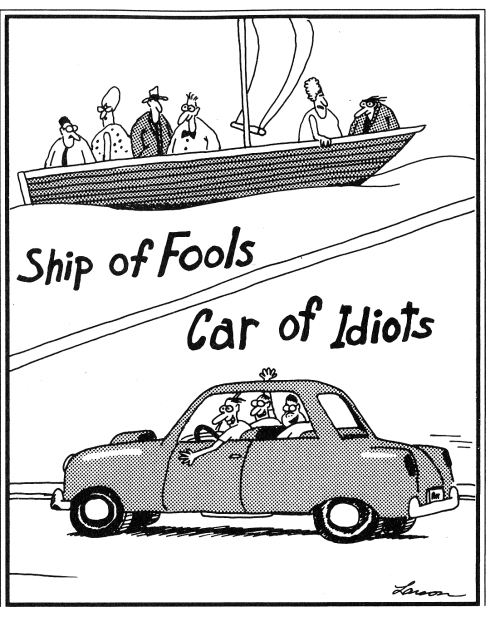
I was never part of a crew.  You have to be popular to be part of a crew, and I wasn’t popular.  I did have friends, but the closest we ever got to being a “crew” was emulating the Car of Idiots from that Far Side cartoon.  We certainly never went water-skiing; I don’t think we ever event went to the beach.  I know that I was certainly embarrassed to take my shirt off in public when I was a teenager (although there wasn’t anything wrong with me, aside from my being skinny), and if you ever did catch me at a lake or at a beach, you’d probably find me with my face buried in a Star Trek or Star Wars EU novel.  Yeah, not exactly the type of person who belongs in a “crew.”

Funny thing, I kind of always wanted to be in a crew and I think it’s commercials like this that helped feed this desire.  That and it seemed like everybody water-skiied in the 1980s.  I remember being dragged to what seemed like an endless stream of barbecues, clambakes, and family parties (okay, it was probably two) where someone had a boat and a pair of water-skis and the entertainment for the evening was seeing how long various partygoers could stay on the skis before they completely wiped out.  Here, everyone seems to be an expert skiier and while some of them do wipe out on occasion, it seems that they all know how to  perform the type of stunts that you’d only see at Sea World. (more…)

White Water Summer

So a couple of weeks ago I noticed that White Water Summer was going to be on one of the random movie channels on the higher end of my digital cable menu (Encore? Flix? FX Movies? Movierama? Video Empire?), I thought, “Yes!  I am SO watching this and blogging about it!”  Then I couldn’t help but laugh when I set up the recording because the of the description that Comcast provided: “Kevin Bacon plays a sadist in charge of adolescents on a camping trip.”

If you take that description at face value along with the title, it sounds like a horror movie, as if Bacon plays the serial killer in some bad Friday The 13th ripoff (which, considering White Water Summer‘s 1987 release date isn’t entirely unrealistic); however, the film is actually a coming-of-age tale that involves Kevin Bacon in one of his douchiest roles, as an outward bound-type counselor named Vic who takes a very reluctant, scared kid named Alan (played by Sean Astin) and several others on a trip into the wilderness.

It’s not a movie that a lot of people have seen–it never made it past its original limited release and I’m sure it wasn’t flying off video store shelves–and it wasn’t well-received, getting a 29% rating on Rotten Tomatoes.  But I have to say that the reason I wanted to blog about this movie isn’t because it is a great piece to play in a game of “Six Degrees of Kevin Bacon” (if anyone actually plays that game anymore), but because this was one of those movies that I rented over and over as a kid and with which I have always felt this oddly deep connection.

As I mentioned, Kevin Bacon’s Vic is an expedition leader who is clearly a full-fledged “nature boy” because when we see him for the very first time, he is walking down the streets of New York City wearing the same fully loaded backpack that you’d wear when hiking through the rough terrain of the Rocky Mountains.  He is there to visit Alan, who is basically Sean Astin in his Goonies phase, as opposed to another, older Alan who narrates the movie, which is Astin in his “Kirk Cameron’s wise-assed sidekick” phase.  This, by the way, was because most of the movie was filmed in 1985 but shelved, then there were Ferris Bueller/Zack Morris-type interstitials where an older Alan would talk to the camera to offer commentary about what was going on that were shot two years later right before the film was released.

Anyway, Alan winds up being convinced (he’s kind of forced) to go on the trip and heads off with three other guys: Mitch (Jonathan Ward, who played middle child Doug Pembroke on the first season of Charles in Charge), George (K.C. Martel, who played Mike Seaver’s friend Eddie on Growing Pains), and Chris (Matt Adler, who starred in the 1987 surfing flick, North Shore).  George and Chris are the older guys who tend to look down on Mitch and Alan and even give Alan the nickname “Dickface.”  They head off to the woods and almost immediately, Alan proves to be the “problem” on the trip–he carves his name in a tree, he doesn’t want to catch a fish with his bare hands, he freaks out when crossing a rope bridge, and is literally left hanging when he’s too scared to rappel across a huge rock formation named Devil’s Tooth.

That’s a huge simplification of most of the movie, but most of what happens is basically tension between the very reluctant and often scared Alan and the “Oh come on, you guys are going to be great at this and if you aren’t, I’m going to push you until you DO WHAT I TELL YOU!!!” Vic.  The other guys do get into it with Vic here and there, especially the night he leaves them all alone in a thunderstorm and they freak the hell out (George, especially, who hams it up rather dramatically).  But for the most part, Alan is “dickface” the entire time and Vic’s their brave leader and a really cool guy.  Until that moment I mentioned in Devil’s Tooth, which is when they all turn on Vic by walking away from him to go back to the ranger station, then when he tracks them down (and is slightly unhinged), beat the crap out of him and break his leg.  So it becomes up to Alan to take a wounded Vic down a raging river to get help (hence, the white water in the summer).

As far as coming-of-age stories go, it is a bit tepid, especially by today’s standards.  There’s no sex, there’s no horror, there aren’t any real quotable linesand one of the few things that you can really laud it for is that it’s shot beautifully.  But I rented this movie at least four or five times between the time I first saw it in 1987 and the time I started junior high school in 1989, which is odd for a kid who was subsiding on a steady diet of Schwarzenegger, Seagal, and Van Damme.  Sean Astin finally getting up the courage to make his way across a dangerous rope bridge and being left to figure out how to rappel over a ravine isn’t exactly Arnold camouflaging himself with mud and setting all sorts of woodland traps for the alien in Predator; and while Kevin Bacon’s Vic is a total jackass, I wouldn’t say that he’s that Bolo Yeung in Bloodsport.  Still, I loved it and still love it because when I was 10 years old, I identified with Alan. (more…)

16 Days of Glory

As of my writing this, we’re about knee-deep in the 2012 London Summer Olympics.  In fact, as I glance over to my television, the NBC Sports Network is showing a U.S.-North Korea women’s soccer match (it was either that or tennis).  I’ve always been a huge fan of the Olympic Games, both summer and winter, especially at how it has me watching and enjoying sports I would never watch otherwise (I went to lunch with some work friends the other day and we watched a water polo match that was on at the restaurant).

This love of the Olympics has its roots in my love of sports, of course, because if I didn’t like sports I wouldn’t care about the Olympics; however, I feel like sometimes I am the only guy who watches the games for the sheer pageantry of it all.  Which is why, by the way, I kept tweeting out snarky bon mots throughout last Friday night’s Opening Ceremonies, pissing and moaning about how badly NBC was mangling their tape-delayed coverage.  In fact, NBC’s fail on this part has been so epic this year it’s like a running joke among tweeters and bloggers, especially those who look forward to the games every four years.

But I’m not going to spend this entry complaining about NBC (that’s what Twitter is for).  No, I thought it might be cool to sit down for a few moments and think about why I am so enthralled by the Olympic Games and why I will spend so much time watching them, even staying up until ungodly hours to watch women’s gymnastics prelims in the summer or a curling match in the winter.  And thankfully it’s not a hard thing to figure out because the very first games I watched were I think the games that people my age think of the most when they think “Olympics.”

Okay, maybe I shouldn’t be speaking for my entire generation but I think that the 1984 Los Angeles Summer Olympics really did come to define “Olympics” for quite a number of Children of the 1980s.

I turned seven in 1984, which meant that this was the first Olympic Games that I actually remember.  I’m sure that people who are even slightly older than me will tell me they have memories of the 1980 Winter Olympics, especially the “Miracle on Ice,” and to that I say that they’re seriously lucky.  Being born in June 1977, I was all of 2-1/2 years old when the underdog U.S. hockey team beat the U.S.S.R. and then Finland to win the gold medal, so if I saw the game against the Russians (which I highly doubt), I don’t remember it at all.  Had there not been a boycott of the Moscow games that same year, I may have seen the 1980 Summer Games, but that wasn’t to be.

The 1984 Summer Olympics soundtrack cassette. This is not available on CD or digitally, so I kind of regret not getting it back in the 1980s when I really wanted it.

So, the summer when I was seven years old and was allowed to stay up slightly later than usual, I saw some of the competition, but most importantly I caught quite a bit of the opening ceremonies.  I don’t know if it was because my parents thought it was important for me to see it or if ABC aired it live instead of on tape delay (which may have been the case — a 3-hour time difference meant it might have aired live; then again, ABC tape delayed the U.S.-Soviet hockey game in 1980 so I wouldn’t put it past them), but I saw quite a bit, including parts of the Parade of Nations (or as my wife put it, “The Model U.N.”).

In my mind, I thought it was the most epic thing I had ever seen (which is saying a lot because I had been watching Star Wars every morning for the past two years).  The audience all had cards on their seats and after a guy came flying in on a jet pack–yes, a JET PACK, which is awesome on so many levels–the PA announcer told them to hold up the cards and the entire stadium was then decorated in the flags of the participating countries.  Plus, you had a theme composed by John Williams that to this day stands as one of my top five John Williams pieces (and next to his NBC News theme, one of his most underrated).  In fact, I loved it so much that when I saw a copy of the soundtrack on cassette at TSS a few years later, I wanted it.  In fact, I coveted that soundtrack so much that I actually took it out of the place where it had been placed and put it behind another cassette on another shelf where nobody but me would find it, not realizing that I probably wouldn’t ever get the money to buy it or that I didn’t have to hide it because it was 1988 and nobody but me was coveting the soundtrack (for the record, I never did get the tape).

(more…)