 There are some moments from Degrassi High that I have been able to picture even without having seen the show in a very long time. Toward the top of that list is Caitlyn Ryan getting caught on a chain link fence.
There’s a lot more happening in this episode, which is the major reason I picked it for a write-up, but I have to admit that it was a favorite of mine in junior high because this is the one where Caitlin dumped Claude (pronounced Clow-de) and I have to be honest, I always hated that guy. Then again, I don’t know if we were ever supposed to actually like Claude because he’s the person who came between OTP Joey and Caitlin. Plus, when I was 12, I had a pretty big crush on her, and my junior high school (and then my high school) was overrun by overwrought guys like Claude who spent every minute ensconsed in their angry young man attitude and Morrissey cosplay.
ANYWAY, the overarching topic of both the A plot and the B plot of this one is causes and community service. The B plot is about the freshmen challenging one another (although this is Canada, so I think it’s “niners”?) to see who can raise more money for UNICEF and it leads to Arthur Yick toilet-papering Mr. Raditch’s house. It’s a generally hearmless comical subplot that cuts through the seriousness of the Caitlin/Claude breakup and the C plot involving Kathleen that I’ll get into later. The Arthur-Yick friendship was one of the strongets when I started watching the show in the DJH years but had become strained. Seeing these two together and having fun was a reminder of that for both of us and them. Plus, the way Raditch busts them by asking them to stop by his house to “pick up some paper” is a great sitcom-y beat.
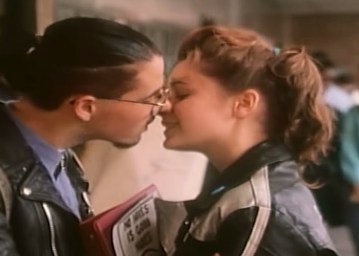
The Caitlin/Claude plot happens simultaneously with that one, as the same night that Arthur and Yick are going TP-ing, they set out to vandalize a munitions factory. This all gets set up a couple of days earlier at the office of People for Peace, the political movement they’re volunteering for. They’ve spent a lot of time making copies and stuffing envelopes–as teen volunteers tend to do–and Claude is frustrated by the lack of direct action. He wants them to take down a local factory that is supposedly helping to manufacture nuclear weapons. When their boss tells him that it’s not on their agenda and chuffs at the idea of throwing bricks through the factory windows, he decides he is going to spray paint the walls. Since Caitlin is so enamored by his dedication to all things causes (and since he’s not that idiot Joey), she goes along with him. But when they get caught by the night watchmen and she gets stuck on a fence while trying to escape, something that was telegraphed by her getting stuck on the same fence while trying to get in, but this time Claude runs off instead of helping her.
Needless to say, this act of cowardice–and Claude being afraid of what his parents would think if he’d gotten caught AND asking Caitlin not to tell anyone from People for People that he’s a huge chicken is the last straw and she dumps him. Not only that, since she was arrested she will have to go to court and this will come up a few episodes later in “Testing, 1-2-3.” That’s a particularly great scene because he tells her he can’t go to court to support her because the night watchman might recognize him and then his parents–who are much more conservative than Cailtin’s–would ground him. For that, she smacks him so hard that she makes his nose bleed (and gets detention where she runs into Joey and they wind up having it out with each other). So Claude’s dumped, he’s a total loser wuss, and there will come a point where we will never see him again.
But more on that in a future post.
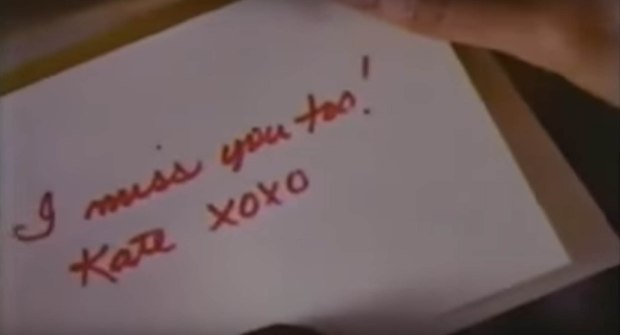
Now, I mentioned the C plot, which is about Kathleen. It’s actually the most serious of the three and the only reason it’s not the A plot is because it’s a follow-up on an earlier episode, “Nobody’s Perfect”, which is all about how her boyfriend, Scott, was physically abusing her. For an Eighties show that could be Afterschool Special at times, itw as written slightly better than some of the other episodes of its kind because it relies on emotional manipulation over the course of nearly half the season as much as it relies on the moments where Scott is shown either verbally or physically abusing Kathleen. After literally getting beaten in “Nobody’s Perfect”, she broke up with him and now he’s decided to start stalking her. This all starts out with “I miss you” over and over until the point where Scott can’t take it anymore and physically attacks her. The end result is that she returns to school with her arm in a sling and a restraining order against Scott.
Kathleen Mead was set up to be one of the more unlikable chararacters in Degrassi. She is a high-strung wet blanket who is also competitive and a perfectionist. It is not without reason, as we have come to see that she is compensating for having a terrible home life (her father is pretty absent and her mom is an aloholic), and the fact that Scott is older than her ties right into her personality and her compensating for things.
Rebecca Haines, by the way, owns this entire storyline and does a fantastic job of carrying her scenes with Byrd Dickens who plays Scott because his line delivery is horrendous*. It’s a challenging storyline that could very well tip too far into melodrama and even when it does, she is very good.
Next up: Check out episode 105 of the podcast, which drops in a week or two, to see how I cover “Stressed Out” and then come back for pot smoking and poker playing in “The All-Nighter.”
*I don’t feel bad for being so mean about this person considering his arrest record.
 I’ve always admired the way that Degrassi High was able to handle the long-term stories of its characters. Spike’s pregnancy and then being a single mom to Emma is probably the most famous (especially since it’s the foundation for the Next Generation series in the early 2000s), but when I rewatched the series, I noticed that the show as really good at following up on episodes and not just through the lens of ongoing relationships like Joey and Caitlin’s. Erica’s abortion, for example, comes back via the fight in “Everybody Wants Something” and then would come up again in “Natural Attraction”, where she starts dating again and Heather is plagued with nightmares about accompanying her sister to the clinic. And LD, who was one of Lucy’s best friends, was diagnosed with leukemia in “Just Friends,” the episode prior to the two-parter I’m looking at here.
 It’s the most self-indulgent, ultra-sized episode of Pop Culture Affidavit EVER!!!
 It’s the second of two “milestone year” episodes as Amanda sits down with me once again for a talk about 1999!
 They’re the 30-second segments you fast-forwarded through, ignored, or used for a bathroom break, but when you think about it, you know them better than you realize. They are commercials. In this episode, I talk about advertising and commercials that I remember, both fondly and not so fondly. I begin by going over what makes a good and a bad commercial and then make my way through a bunch of commercials that I can’t get out of my head. From cereal to fast food to toys to local car dealerships, it’s so much advertising that it’s … INSANE!
 How much do we accumulate and hold onto? How much of it do we actually need? In this episode, I take you behind my new endeavor and new blog, “The Uncollecting”, which is “One Nerd’s Efforts to Let Things Go.” I talk about what brought me to want to consume and get rid of what I haven’t read, watched, or listened to, and go over four pieces of related popular culture. First, there is a 2007 episode of The Oprah Winfrey Show, which features Oprah trying to help a woman who had been hoarding. Second is the show Clean House, which aired on the Style Network in the 2000s. Third is Netflix’s Tidying Up. Finally, there is the recent “Potter’s House” series on the YouTube channel Curiosity Inc.
 It’s the first of two “milestone year” episodes where Amanda and I sit down and take a pretty thorough look at what was going on in a particular year of the 1990s. First up, 1995. Join us as we talk about where we were in our lives in ’95 and then run through the television shows, movies, and music of that year.